
← The Chronicle · Learn the Moves
What Happens After an Illegal Move in a Chess Tournament?
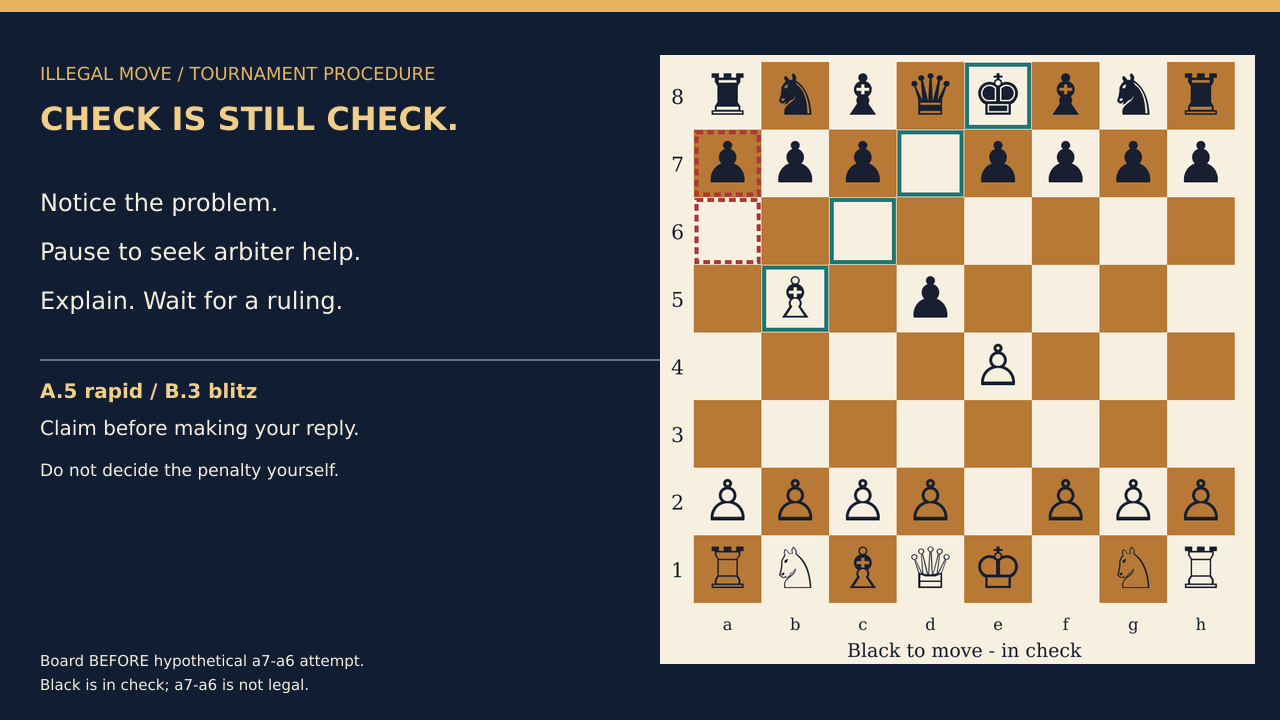
If you think an illegal move has been completed, pause the chessclock to seek the arbiter’s assistance, explain what happened and wait for a ruling; do not decide the penalty yourself.[1] Under FIDE rules, the answer depends on whether the move was completed, whether it is that player’s first or second completed illegal move, and which standard, rapid or blitz procedure applies.[1]
A first illegal move is not automatically a loss under FIDE Article 7.5.5. That article gives extra time to the opponent for a first completed illegal move and a loss for a second by the same player, with a draw exception when the opponent cannot possibly checkmate through any series of legal moves.[1] The amount of extra time—and whether a mistake can still be corrected after the reply—needs the qualifications below.[1]
First, find out which rules govern your event
This guide explains FIDE over-the-board procedure, using the Laws taking effect from 1 January 2023.[1] Before the round, ask the organiser: “Which rulebook applies, and which rapid or blitz appendix procedure are we using?” Treat this as a question to resolve, not permission to import FIDE penalties into every school tournament, national-federation event or online game.
For FIDE rapid and blitz, the event regulations must specify which of the two relevant supervision procedures applies for the entire event: A.4 or A.5 for rapid, B.2 or B.3 for blitz.[1] Having an arbiter somewhere in the room is not the same as satisfying the particular supervision and game-recording conditions.[1]
What counts as a completed illegal move?
An illegal move fails the relevant movement requirements in Articles 3.1–3.9; leaving your own king in check is one example.[1] Under Article 7.5.1, an illegal move is completed when the player presses the clock.[1] A hand leaving a piece and a clock press are therefore not interchangeable checkpoints.[1]
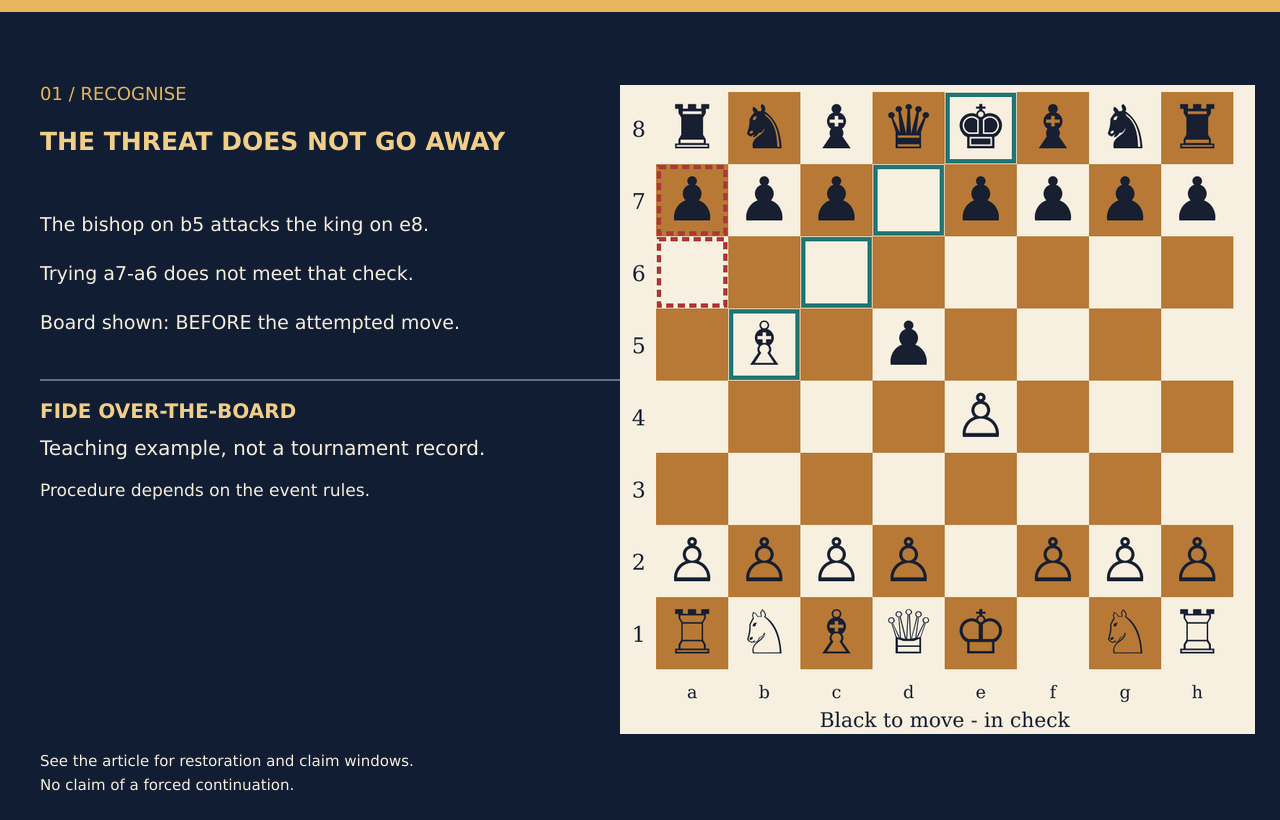
View full illustration (opens in a new tab)
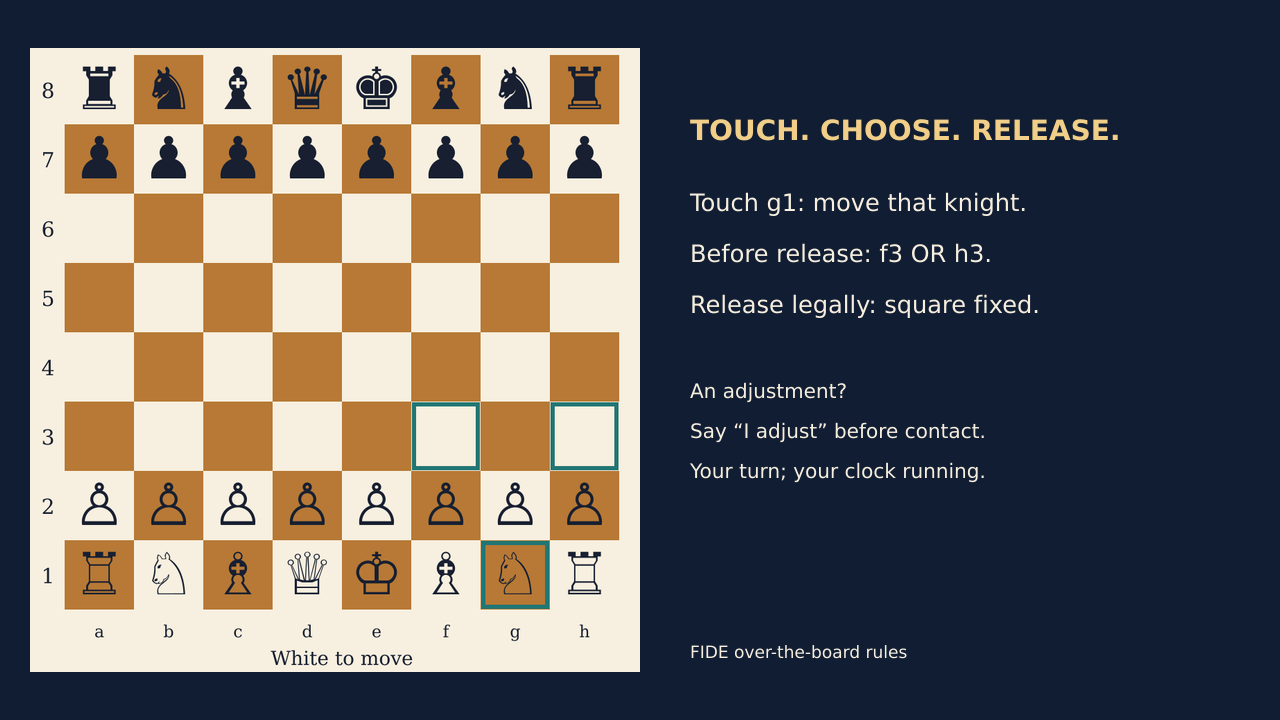
Before a clock press, an illegal placement does not become legal merely because the piece was released: Article 4.7 describes release as part of a legal move, and touch-move obligations may still constrain the correction.[1] For the handling details rather than the penalty procedure, see touch-move and adjusting pieces.
Article 7.5 also covers three easy-to-miss situations: pressing the clock without making a move; using two hands for a single move and then pressing the clock; and reaching the promotion rank, pressing the clock, but leaving the pawn unexchanged.[1] In that last situation, Article 7.5.2 requires the pawn to be replaced with a queen of the same colour.[1]
A knocked-over piece is not automatically the same issue: Article 7.4 requires a player who displaces pieces to restore the correct position in their own time, with arbiter assistance if needed.[1] Describe the actual action rather than assuming that every board disturbance earns the illegal-move penalty.
At the board: pause, explain, wait
- Pause both clocks to request help. FIDE permits a player to pause the chessclock to seek the arbiter’s assistance; the arbiter decides whether the reason was valid.[1]
- Leave the disputed position available to inspect. Explain which move you believe was illegal, whether the clock was pressed and whether a reply has been made. This is practical preparation for a ruling, not a substitute for one.
- Call the arbiter calmly. A useful phrase is: “Arbiter, I think the last move was illegal. Could you check the position?” This is suggested wording, not a rulebook quotation.
- Let the arbiter direct the correction and restart. The Laws give the arbiter responsibility for the relevant clock adjustments and for deciding when play resumes.[1]
Do not play a reply while hoping to claim afterward: under the A.5 rapid procedure, also used by B.3 blitz, making the next move closes the ordinary claim window.[1] Notice that A.5.2 says made the next move, not “pressed the clock after the next move.”[1]
Parents and spectators should not announce the error across the board or coach a response: someone who observes an irregularity may inform only the arbiter, and spectators must not interfere.[1] A child can use the same short request for help as an adult; there is no need to argue the whole rulebook at the table.
Standard chess: restoration, extra time and a second offence
Under Article 7.5.1, when a completed illegal move is found during the game, the position immediately before it is reinstated; if that position cannot be determined, play resumes from the last identifiable position before the irregularity.[1] Articles 4.3 and 4.7 apply to the replacement move, so correction is not automatically a free choice of any piece or destination.[1]
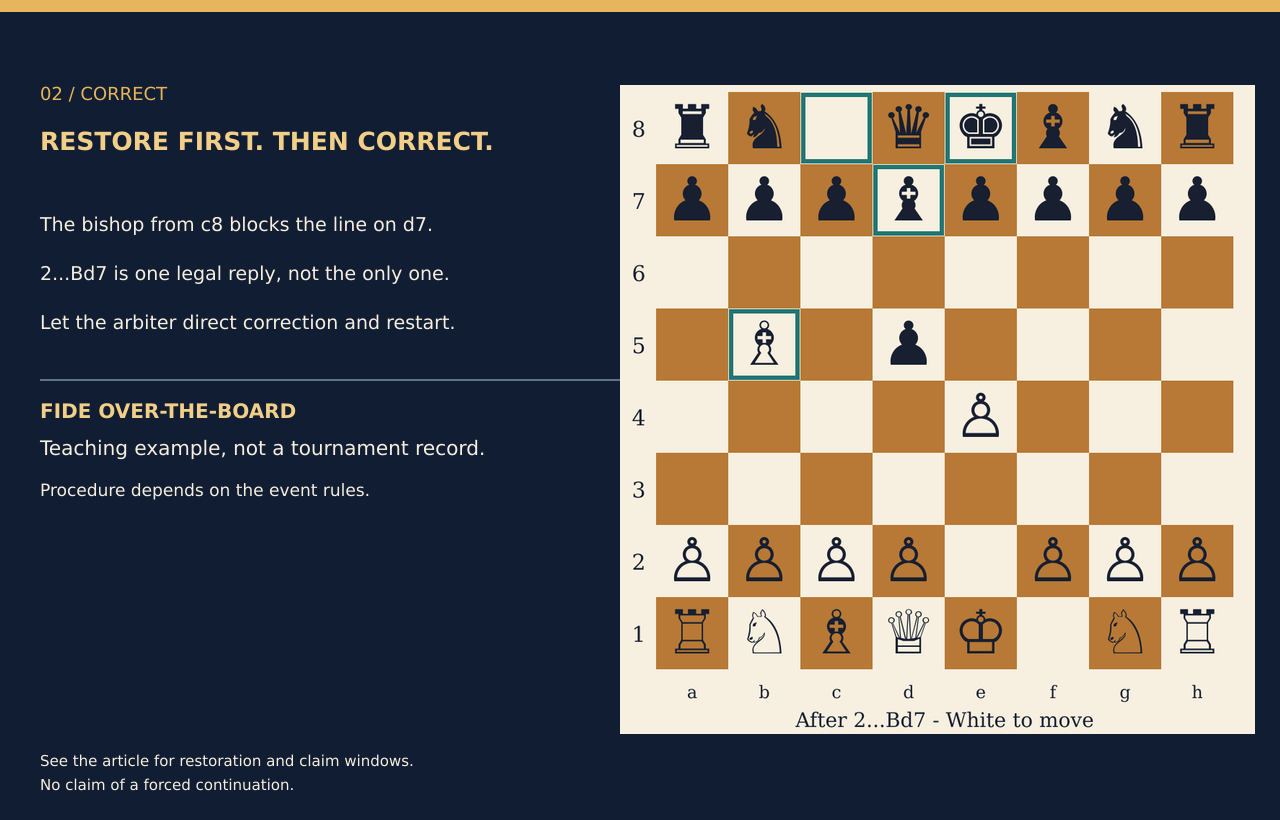
View full illustration (opens in a new tab)
For the first completed illegal move by a player, Article 7.5.5 awards the opponent two extra minutes after the corrective action.[1] For the second completed illegal move by that same player, the arbiter declares that player lost, unless the opponent cannot checkmate that player’s king by any possible series of legal moves; then the game is drawn.[1] This is a count for each player separately, not a shared allowance for the game.[1]
The draw exception is not “my opponent probably could not win.” The test is whether checkmate is possible through any legal sequence, not whether either player would find it in normal play.[1] Leave that determination to the arbiter rather than trying to prove it in an argument while the clocks run.
Clock restoration is a separate decision from the time penalty: under Article 7.1, the arbiter uses best judgement about the times to show and may decide not to change them, adjusting the move-counter if necessary.[1] Do not assume that every second spent after the mistake is automatically refunded.[1]
Rapid and blitz: the supervision branch matters
The rapid and blitz labels alone do not tell you the complete correction procedure.[1] For help understanding the formats themselves, use the separate rapid, blitz and daily chess overview; here the question is how an over-the-board irregularity is handled.
Rapid under A.4: supervised and recorded
A.4 applies the Competitive Rules of Play when one arbiter supervises at most three games and each game is recorded by the arbiter or an assistant, electronically if possible.[1] The restoration procedure therefore follows the competitive rules, but A.3 changes the Article 7 and Article 9 two-minute penalties to one minute.[1] A first completed illegal move accordingly adds one minute to the opponent; the second by the same player still invokes Article 7.5.5’s loss/draw rule.[1]
Rapid under A.5: claim before making your reply
Under A.5.2, an arbiter who observes the relevant Article 7.5 action acts under Article 7.5.5 only if the opponent has not made the next move; if the arbiter does not intervene, the opponent may claim within that same window.[1] The rapid first-offence time addition is one minute, through A.3.[1]
If neither intervention nor a claim occurs before the opponent makes the next move, the illegal move stands and the game continues.[1] After that reply, A.5.2 allows correction only if the players agree, without arbiter intervention.[1] That is not an invitation to insist on a standard-chess rewind after missing the claim window.
Blitz under B.2 versus B.3
B.2 applies the Competitive Rules of Play when one arbiter supervises one game and the game is recorded by the arbiter or an assistant, electronically if possible.[1] On that B.2 branch, Article 7.5.5 supplies the two-minute first-offence addition and the second-offence loss/draw rule; B.2 does not import rapid’s A.3 substitution.[1]
Otherwise, B.3 expressly applies rapid Articles A.2, A.3 and A.5: that means the one-minute first-offence addition and the before-the-next-move claim window described above.[1] “Blitz always means a one-minute penalty” is therefore too broad for these FIDE Laws.[1]
What if the mistake is discovered later?
In standard chess, and under the competitive-rules supervision branches, Article 7.5.1 provides for restoration when a completed illegal move is found during the game; it does not set A.5.2’s next-move claim deadline.[1] Help the arbiter identify the earlier position rather than guessing a replacement arrangement.
Under A.5 rapid or B.3 blitz, use the missed-window rule above instead.[1] There is also a special A.5.4 rule: if the arbiter observes both kings in check, or a pawn on its furthest rank, the arbiter waits until the next move is completed and declares a draw if an illegal position remains.[1] This narrow provision does not make every unnoticed illegal move an automatic draw.[1]
These are during-game procedures, not a promise that a finished result will be reopened. If an issue comes to light after the game, report it to the arbiter and ask about the event’s applicable reporting or appeal procedure; this guide does not establish a universal post-game remedy.
Three short procedure rehearsals
1. A player leaves their king in check and presses the clock in standard chess. Treat this as a hypothetical first completed illegal move by that player, with the game still in progress: request the arbiter, who applies restoration and the two-minute addition to the opponent under Article 7.5.[1] Do not declare the game lost simply because this is the first mistake.[1]
2. An A.5 rapid opponent presses the clock after an illegal move, and you have not replied. Pause to request the arbiter and state the claim before making your next move; A.5.2 preserves that claim window, with A.3’s one-minute first-offence addition where applicable.[1] The practice point is the order of your actions, not a race to change the clock yourself.
3. In B.3 blitz, you notice the earlier illegal move only after making your reply. A.5.2 now governs through B.3: ordinary arbiter correction is no longer available for that move, though the players may agree to correct it without arbiter intervention.[1] Do not rehearse this as “blitz has no correction rules” or as “every late discovery forces a rewind.”
These are rule-application examples, not reports of actual tournament games.
A small checklist before your next round
Ask which rulebook governs, which appendix procedure applies and how to call an arbiter. Then rehearse one calm sentence and the clock’s pause control before play begins.
Keep the essential distinction: notice the problem, seek a ruling before replying, and let the arbiter handle the remedy.[1] Knowing a possible penalty is useful; knowing how to ask for help without making the situation harder is the skill to practise.
Sources
Related stories
Learn the Moves
Touch-Move at the Board: Moving, Capturing and Adjusting Pieces
Touch chooses a movable piece; legal release fixes its destination. Know when and how to announce an adjustment.
Read the story →
Learn the Moves
Rapid vs. Blitz vs. Daily Chess: Which Should Beginners Play?
Start with room to notice threats, not just room to click. Compare per-player clocks and per-move deadlines, then choose a pace you can finish.
Read the story →