
← The Chronicle · Learn the Moves
Rapid vs. Blitz vs. Daily Chess: Which Should Beginners Play?
You see the threat and reach for the piece. The clock has already made the choice feel urgent. Was the move wrong, or did you never get a chance to look?
Start with rapid and an increment. 15+10 is the one to try. Each player gets 15 minutes, and 10 seconds come back on every move. That is enough time to run a short check before you touch a piece, and it is not an all-day game. If you cannot sit for a continuous game, play daily. Keep blitz for fun. Do not make it the only way you practice.
Checkered Crown's Play room is where you can try the habit. A Coach review is for a finished game. Do not send a live game out for advice while it is still going.
Read the clock
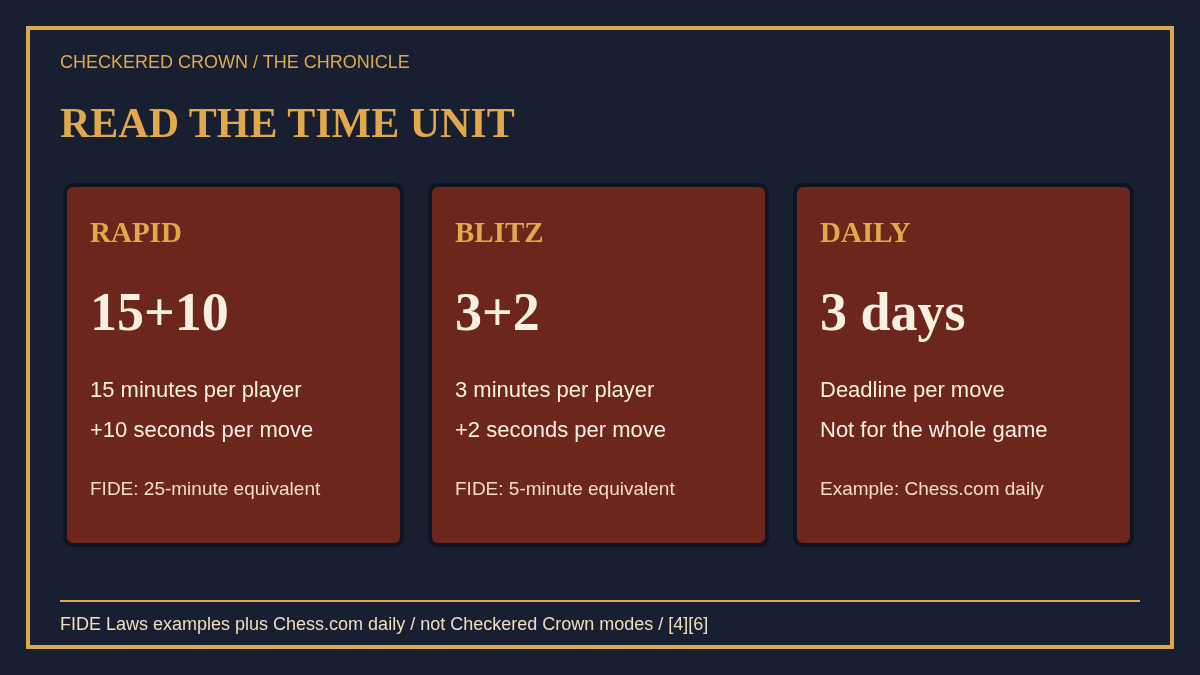
15+10 is not 15 minutes plus 10 minutes at the end. The 15 belongs to each player. The 10 is added after each move. A delay is different. The clock waits, then counts. Read the setting on the site you are playing. Do not treat the two as the same thing.
Daily changes the unit. On Chess.com each player gets a deadline measured in days per move, not minutes for the whole game. A daily game can run for weeks. It does not mean one move every evening, and it does not mean the game lasts one day.
Rapid
Under the FIDE laws, rapid is more than 10 minutes and less than 60 per player. With an increment, the label uses the start time plus 60 increments. 15+10 counts as 25 minutes for that label. Your game will not last exactly 25 minutes. That is only how the control is classed.
The reason to start here is a four-line check:
- What changed on their last move?
- Is my king in check, or about to be?
- What is hanging, theirs and mine?
- What does my move allow?
That is a habit, not a demand to see every line. If you have the time and skip the check, a slower clock will not fix it. Do not book something for 15 minutes after the start. Their clock, your clock, and the increments all count.
Blitz
Blitz is 10 minutes or less per player, same 60-increment rule. 5+0 and 3+2 are blitz. 3+2 counts as 5 minutes for the label. It is fun, and it shows whether you know a pattern on sight. For a beginner it is also a string of missed threats. Another game is not a review.
You do not have to wait for a rating to try it. Play one when you want a fast game. Then ask if you can explain a decision you made. If every loss is a blur, put the practice back on rapid. One naming trap: 10+0 is blitz under the FIDE laws, even if a site badges it rapid. Read the time, not the badge.
View full illustration (opens in a new tab)
Daily
Daily fits a player who can look at a position and cannot sit for a session. You come back inside the deadline and look again. The cost is continuity. Start from their last move, not from a plan you half remember. If several games are open, check which board you are on. One or two is enough. More boards are not more practice.
Extra time is not a license to ask an engine. Chess.com bars engines, tablebases, and help from other people in live daily games. It does allow some books and opening databases, without an engine evaluation. Other sites differ. Read the rules where you play. Do not send an unfinished competitive game to an AI coach. Review it after the result.
A board to look at
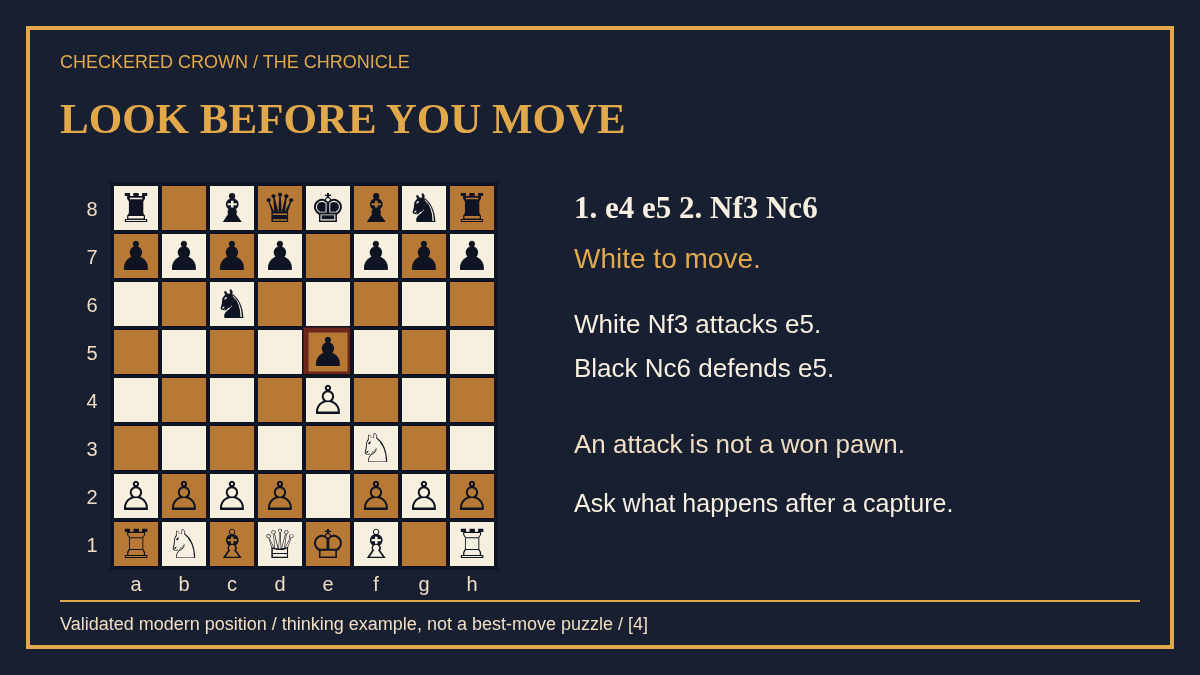
After 1.e4 e5 2.Nf3 Nc6, White is to move. The knight on f3 attacks the pawn on e5. The knight on c6 defends it. The pawn on e4 is not defended by another white piece. "I attack a pawn" and "I can take a pawn" are not the same sentence. A slower clock gives you time to ask what happens after the capture. You still have to ask.
Read the diagram description
White to move after 1. e4 e5 2. Nf3 Nc6. White: king e1; queen d1; rooks a1 h1; bishops c1 f1; knights b1 f3; pawns a2 b2 c2 d2 e4 f2 g2 h2. Black: king e8; queen d8; rooks a8 h8; bishops c8 f8; knights c6 g8; pawns a7 b7 c7 d7 e5 f7 g7 h7. White knight f3 attacks e5; Black knight c6 defends e5; no White piece currently defends the White pawn e4.
View full illustration (opens in a new tab)
One cycle
Play one slower game. Use the check before you move. Afterward pick one moment: a threat you missed, a piece you left loose, or time you spent without deciding what to look at. Write what you saw too late. The next game has one job. Before you move a piece, see what stops defending it.
If rapid is impossible because you cannot stay, play daily. If daily games expire because you forget them, play a live game you can finish. If blitz is the fun one, keep it. Do not let the next quick game replace the review.
Put the routine into practice: Let's play in the Checkered Crown Play room. For the review format, see a sample Coach review.
Sources
Related stories
History Behind the Story
How Chess Traveled from India to Medieval Europe
Chess did not arrive in Europe as a finished modern game. Follow its cultural connections and the rule changes that transformed its pieces.
Read the story →