
← The Chronicle · Learn the Moves
Touch-Move at the Board: Moving, Capturing and Adjusting Pieces
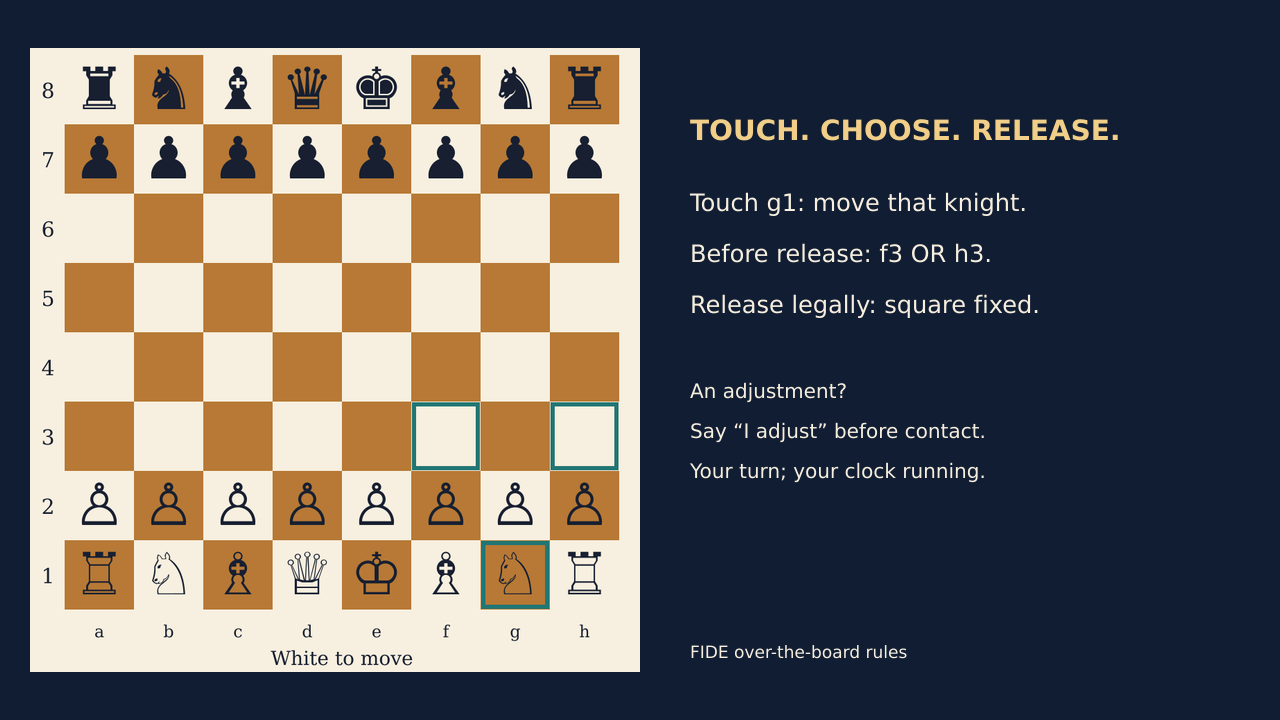
Under FIDE rules, touching your own piece with the intention of moving commits you to moving the first touched piece that has a legal move; touching an opponent’s piece with the intention of capturing commits you to capturing the first touched piece that can legally be captured.[1]
To straighten a piece without moving it, first say “I adjust” or “j’adoube,” and do so only when you have the move; in a clocked game, only the player whose clock is running may adjust pieces.[1]
The useful distinction is between choosing a piece by touching it, fixing its destination by releasing it legally, and completing the move on the clock: these are not the same moment.[1]
This guide explains the FIDE Laws of Chess taking effect from 1 January 2023, whose stated scope is over-the-board play.[1]
It does not describe website controls, app settings or national-rule variations. For an event using another ruleset, ask its arbiter which rules apply.
Touching your own piece: you choose the piece before the square
On your turn, if you touch one or more of your own pieces intending to move, you must move the first piece touched that can legally move, not whichever touched piece you prefer afterward.[1]
Putting that piece back on its original square does not remove the obligation: the rule attaches to the touch, not just to lifting or releasing it.[1]
But touching a piece does not necessarily choose its destination: while still holding it, you may choose among its legal destinations, subject to any other touch-move obligations.[1]
Once you release it on a square as a legal move or part of a legal move, you cannot transfer it to another square on that move.[1]
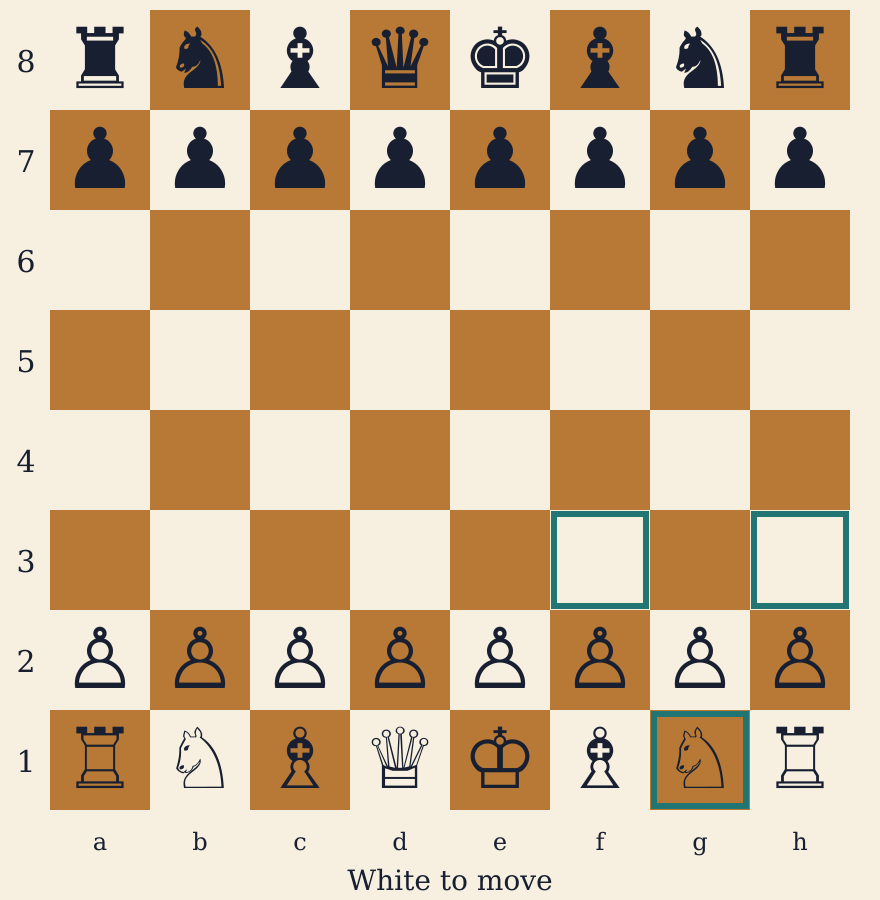
For a beginner’s example, start from the normal initial position and imagine that White intentionally picks up the knight on g1: White must move that knight, but may choose f3 or h3 before releasing it legally.[1]
Those are alternative choices, not a two-move sequence. Try the example on a practice board, not during someone else’s game.
Read the diagram description
Normal starting chess position, White at bottom. White knight g1 and its two legal destinations f3 and h3 are outlined.
View full illustration (opens in a new tab)
What if the piece cannot move legally?
Touch-move never gives permission to make an illegal move: you cannot leave your king in check or expose it to check.[1]
If the first piece touched has no legal move but a later touched piece does, the first legally movable touched piece is the one that must move.[1]
If none of the pieces touched under the relevant touch-move provisions can be legally moved or captured, you may make any legal move.[1]
Do not confuse “I do not like its legal moves” with “it has no legal move.” A move that loses material can still be legal.
Touching an opponent’s piece: capture if legally possible
If you touch one or more opposing pieces with the intention of capturing, you must capture the first touched opposing piece that can legally be captured.[1]
If more than one of your pieces could legally capture that target and you have not already committed one of your own pieces by touching it, the opponent-piece rule does not by itself select your capturing piece.[1]
If no touched opposing piece can legally be captured, the rule does not require an impossible capture; the no-legal-move-or-capture provision allows another legal move.[1]
What if you touch pieces of both colours?
FIDE gives this situation its own sequence: capture the first touched opposing piece with your first touched piece, if that capture is legal.[1]
If it is illegal, move or capture the first touched piece that can legally be moved or captured.[1]
If nobody can establish whether your piece or the opponent’s piece was touched first, FIDE treats your own piece as having been touched first.[1]
The practical lesson is to decide on the capture before handling either piece. If the order is disputed, explain what happened to the arbiter rather than testing more moves on the board.
Saying “I adjust”: before contact, on your turn
FIDE permits the player having the move to adjust one or more pieces on their squares, provided that the player first expresses that intention, for example by saying “j’adoube” or “I adjust.”[1]
You do not need a special French phrase: “I adjust” is explicitly given in the rule.[1]
Make the intention clear before contact, then straighten the piece within its square. Saying “adjust” after touching a piece does not meet the rule’s requirement to express the intention first.[1]
An adjustment is not permission to try a move and put it back, nor permission to tidy pieces during the opponent’s turn; with a chessclock, your own clock must also be running.[1]
A useful home-practice routine is: wait for your turn, say “I adjust,” centre one piece, and take your hand away. Practise the words before playing a timed game together.
What about an accidental brush or a knocked-over piece?
FIDE expressly excludes clearly accidental contact from the contact it treats as intent; other physical contact is considered intentional under its rule.[1]
So a clearly accidental brush is different from deliberately handling a piece and later saying that you had not decided to move it.[1]
Displacing pieces raises a separate duty: the player who displaces them must restore the correct position in their own time, and either player may pause the clock and ask the arbiter for help if necessary.[1]
The arbiter may penalise displacement; “accidental” is not a blanket exemption from restoring the position or from every possible consequence.[1]
Release, “made” and “completed”: three different questions
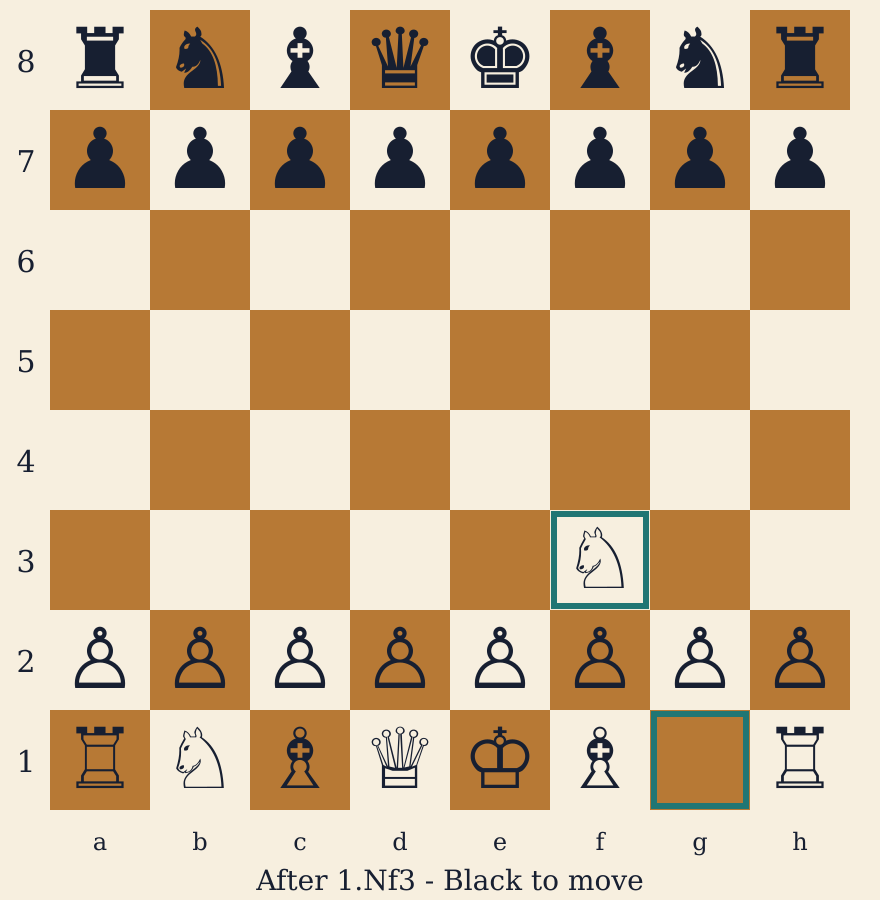
For an ordinary legal non-capturing move, releasing the piece on its new square fixes that move’s destination; not having pressed the clock is not a chance to take it back.[1]
Read the diagram description
Starting position after White plays Nf3: the white knight is on f3, g1 is empty, and all other pieces remain on their initial squares. White at bottom.
View full illustration (opens in a new tab)
FIDE says a player has the move once the opponent’s move has been made, not only after the opponent presses the clock.[1]
In competitive play, making the move on the board and then pressing your clock normally completes it; the time between those actions remains part of your allotted thinking time.[1]
A player must still be allowed to press their clock after making a move even if the opponent has already made the next move.[1]
There are completion exceptions: a game-ending move is completed without requiring a clock press, and a player’s previous uncompleted move is also completed if that player makes their next move.[1]
Play each move with one hand, and press the clock with the same hand used to make the move.[1]
Captures
For a capture, the move is made when the captured piece has been removed and you have placed and released your capturing piece on its new square.[1]
Merely lifting the opposing piece off the board does not finish that sequence.[1]
Castling
In ordinary chess, touching king and rook commits you to castling on that side if legal; deliberately touching the rook before the king instead prevents castling on that side on that move and invokes the own-piece touch rule.[1]
When intending to castle, if you touch king then rook but castling with that rook is illegal, you must make another legal king move, possibly castling with the other rook; if the king has no legal move, you may make any legal move.[1]
Releasing the king during legal castling does not yet mean the move has been made, but you are no longer free to choose another move instead: the move is made when you release the rook on the square the king crossed.[1]
If castling on that side is illegal after releasing the king, the rule again requires another legal king move if available, including possible castling on the other side.[1]
This is a handling explanation, not a complete castling-legality checklist or a Chess960 guide. For the squares and safety conditions, use the castling legal-move checklist.
Promotion
Promotion has two distinct commitment points: the choice of new piece is finalised when that piece touches the promotion square, while the move is made when the new piece has been released there and the pawn has been removed.[1]
Do not assume that you can swap the chosen promotion piece merely because your hand is still holding it.[1]
For what each replacement can do, compare the four promotion choices and underpromotion examples.
What if the released move was illegal?
The release rule is stated for a legal move or part of a legal move; it does not turn an illegal move into a legal one.[1]
FIDE’s illegal-move correction procedure still applies, and its replacement move remains subject to the touch-move and release provisions.[1]
Ask the arbiter to resolve the situation rather than treating a mistake as a free choice of any new move. Detailed illegal-move penalties are outside this guide.
If you think touch-move was broken
Raise the issue before you touch a piece intending to move or capture: doing so forfeits your right to claim against your opponent’s violation of the handling rules in Articles 4.1–4.7.[1]
Explain the contact, the order of touches and whether an adjustment was announced. You may pause the chessclock to seek the arbiter’s assistance, but the arbiter decides whether the reason was valid; an invalid reason for pausing can be penalised.[1]
Players are entitled to ask the arbiter for an explanation of a point in the Laws of Chess.[1]
For parents watching a tournament, do not coach a child or argue a claim over the board: spectators must not interfere, though someone who observes an irregularity may inform the arbiter.[1]
A short family rehearsal
Use the normal starting position for these practice questions. They are teaching examples, not a tournament test.
- You deliberately pick up White’s g1 knight, then prefer a pawn move. May you switch? No: that knight has legal moves, so touch-move commits you to moving it.[1]
- Before releasing that knight, may you choose between f3 and h3? Yes: both are legal destinations from the starting position, and no other touched piece is involved in this example.[1]
- Your knight is off-centre and it is your turn. What should you say first? “I adjust,” before touching it; when using a clock, your clock must also be running.[1]
- You legally release the knight on f3 but have not pressed the clock. May you put it on h3 instead? No: the legal release has fixed the destination already.[1]
Then let each learner invent an adjustment scenario and explain the correct sequence in their own words. For your next family game, try the simple reminder: think first, announce an adjustment before contact, and make the move before pressing the clock.