
← The Chronicle · Learn the Moves
The 50-Move and 75-Move Rules: What Resets the Count?

Castling does not reset the 50-move count.[1] The count restarts only when a pawn moves or a piece is captured; a king move, a rook move and castling do neither.[1] Under FIDE rules, 50 moves by each player without either event can support a draw claim, while 75 moves by each player produce an automatic draw unless the last move checkmates.[1]
That is the useful distinction: what changes the count, who must claim, and when the game ends without a claim. Here is a practical way to keep those questions separate, with three composed positions to try after a game.
This guide explains FIDE's over-the-board Laws of Chess, not the draw-button behaviour of a particular website or app.[1] The Laws explicitly cover over-the-board play; check your platform's own rules and interface before assuming its procedure is identical.[1]
Fifty moves means fifty moves by each player
The 50-move rule is not a limit of 50 individual turns shared between both players.[1] FIDE specifies the last 50 moves by each player, without any pawn move and without any capture.[1]
For counting, call one player's turn a halfmove: White moves, then Black moves, giving two halfmoves. Fifty moves by each player therefore make 100 halfmoves, and 75 by each player make 150 halfmoves.[1] These are two thresholds for the same uninterrupted sequence, not two separate counters.[1]
Imagine a small tally beside the board. After a pawn move or capture, put the tally at zero.[1] After any other move, add one.[1] That tally describes the move-count condition; it does not decide whether another rule has already ended the game.[1][1]
The ordinary move number is different. A game reaching move 60 has not necessarily reached either draw threshold: a recent pawn move or capture may have restarted the relevant sequence.[1] Count from the last reset, not from the beginning of the game.[1]
What resets the count—and what does not?
Any pawn move resets it, whether the pawn advances one square or two, captures, or promotes.[1] Any capture also resets it, including a capture made by a king or another non-pawn piece.[1] The rule asks whether any pawn moved or any capture occurred, not whether an exchange was tactically important.[1]
A quiet queen, rook, bishop, knight or king move does not reset it.[1] Giving check without moving a pawn or capturing does not reset it either.[1] Moving to a position that has never appeared before is not an extra reset condition: repetition and move counting answer different questions.[1]
Why castling is not a reset
Castling moves the king and a rook, but FIDE counts it as a single move of the king.[1] It is not a pawn move and it is not a capture, so it adds one halfmove to an uninterrupted sequence instead of restarting it.[1]
This is easy to confuse with castling rights. Losing the right to castle changes what moves are available, but it does not turn a king or rook move into a pawn move or capture.[1] Do not use “something irreversible happened” as a substitute for the actual reset rule.[1]
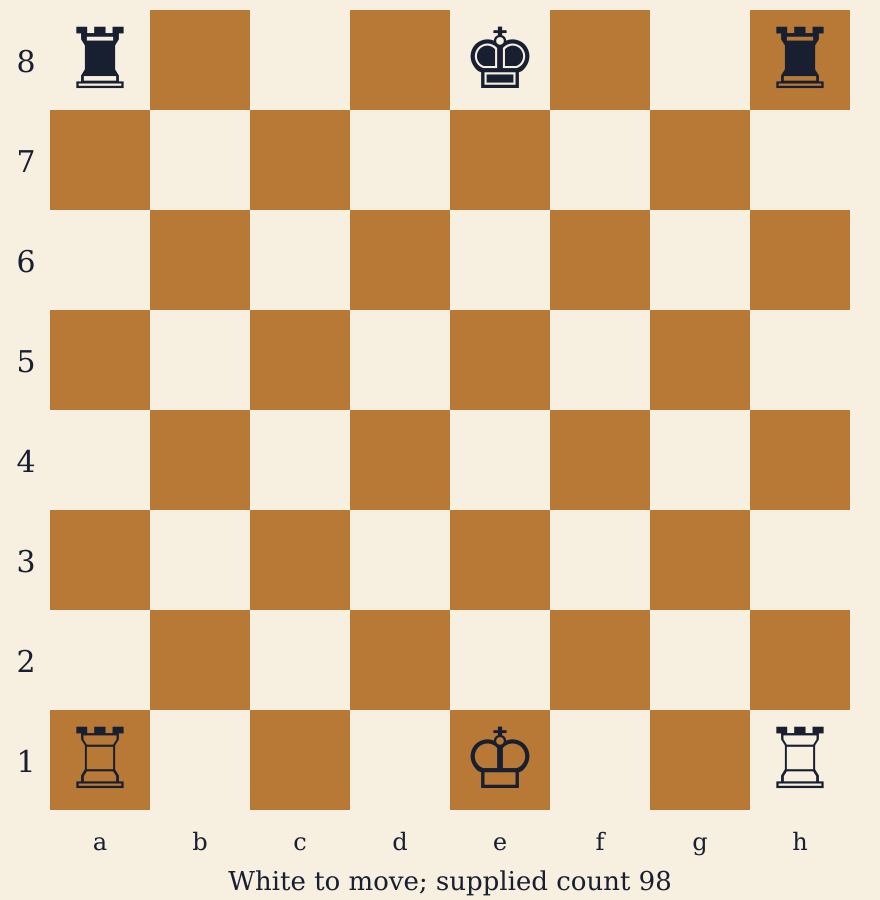
In this composed example, White has a king on e1 and rooks on a1 and h1; Black has a king on e8 and rooks on a8 and h8. White moves next and both sides retain castling rights. The supplied halfmove count is 98.
Read the diagram description
White king e1 and rooks a1 and h1; Black king e8 and rooks a8 and h8. White to move, supplied count 98. All unlisted squares are empty. Coordinates run a–h left to right and 8–1 top to bottom. See the adjacent text for the alternative moves; supplied counters are exercise inputs, not reconstructed game histories.
View full illustration (opens in a new tab)
White can play O-O legally here. The king goes to g1 and the rook to f1; the count becomes 99. In a separate branch from the same starting position, Rxa8+ captures Black's a8 rook and resets the count to zero. The difference is the capture, not the rook's distance travelled.
The position is supplied as FEN: r3k2r/8/8/8/8/8/8/R3K2R w KQkq - 98 50. Its counter and rights are teaching inputs, not a claim that we reconstructed the preceding game.
The 50-move rule requires a correct claim
At 50 moves by each player without a reset, the FIDE rule is claim-based.[1] A player who has the move can claim when the required sequence has already been completed.[1] Reaching that threshold alone is not the same as the automatic 75-move draw.[1]
There is also an intended-move procedure.[1] If your next move will complete the required sequence, first record that move on the scoresheet and declare to the arbiter that you intend to make it.[1] The indicated move cannot be changed.[1] Do not play it first and then assume you still have the same claim opportunity.[1]
FIDE also says that touching a piece with the intention of moving or capturing it loses the right to claim under this rule on that move.[1] When considering a claim, settle the procedure before reaching for a piece.[1]
One quiet move or one pawn move?
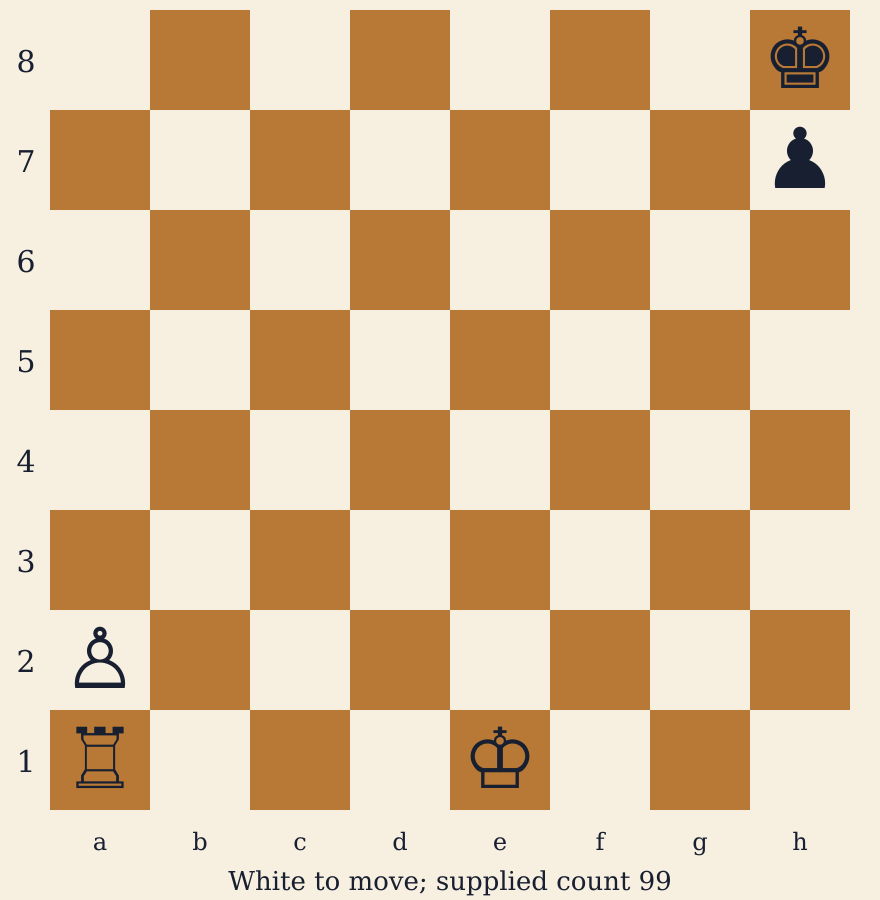
Here White has a king on e1, a rook on a1 and a pawn on a2. Black has a king on h8 and a pawn on h7. White is to move with a supplied count of 99. Compare two alternatives, not a forced tactical solution.
Read the diagram description
White king e1, rook a1 and pawn a2; Black king h8 and pawn h7. White to move, supplied count 99. All unlisted squares are empty. Coordinates run a–h left to right and 8–1 top to bottom. See the adjacent text for the alternative moves; supplied counters are exercise inputs, not reconstructed game histories.
View full illustration (opens in a new tab)
Rb1 is a legal non-capturing rook move and brings the count to 100. White could use the intended-move claim procedure before playing it, provided the preceding sequence is established.[1] If White instead plays a3, the pawn move restarts the count; the old 99 halfmoves do not carry over.[1]
After Rb1 has actually been played, Black has the move. With the completed sequence established, Black can make a claim under the completed-moves provision.[1] This is why “I can claim before my intended move” and “I can claim after the opponent's move” should not be muddled together.[1]
The supplied FEN is 7k/7p/8/8/8/8/P7/R3K3 w - - 99 60. A FEN snapshot is useful for an exercise, but an actual over-the-board claim depends on the game's record and the arbiter's assessment, not our invented starting tally.
What happens when you claim?
Under Article 9.5, the player or arbiter pauses the chessclock for a claim, and the claim cannot be withdrawn.[1] A correct claim immediately draws the game.[1] For an incorrect claim, the opponent receives two extra minutes and play continues; if the claim was based on an intended move, that move must be made in accordance with the rules.[1]
For a tournament dispute, ask the arbiter rather than arguing over a remembered number. FIDE makes checking a 50-move claim a duty of the players under the arbiter's supervision.[1]
The 75-move rule is automatic—with a mate exception
Article 9.6.2 draws the game when at least 75 moves have been made by each player without any pawn movement or capture.[1] Unlike Article 9.3, this provision does not require a player's correct claim.[1] It also explicitly says that checkmate on the last move takes precedence.[1]
So the 50-move threshold is not an extra allowance that starts another 75-move count.[1] Both refer to the same uninterrupted sequence.[1] A pawn move or capture before either threshold restarts that sequence.[1]
Checkmate on halfmove 150
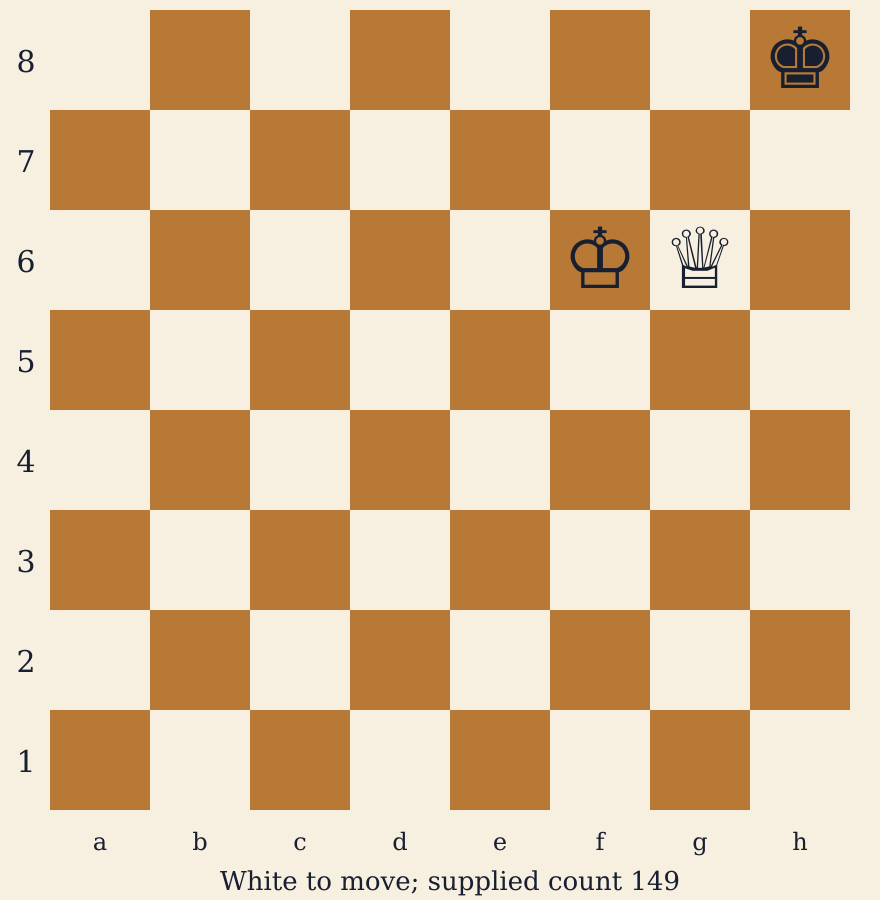
In the final example, White's king is on f6 and queen on g6; Black's king is on h8. White moves next, and the supplied count is 149. The exercise tests the final move, not how this position arose.
Read the diagram description
White king f6 and queen g6; Black king h8. White to move, supplied count 149. All unlisted squares are empty. Coordinates run a–h left to right and 8–1 top to bottom. See the adjacent text for the alternative moves; supplied counters are exercise inputs, not reconstructed game histories.
View full illustration (opens in a new tab)
White can play Qg7#. The queen checks the king on h8, the queen covers g8 and h7, and White's king protects the queen on g7. Black has no legal reply. Although the non-capturing queen move brings the count to 150, the result is a win by checkmate, not a draw.[1][1]
The supplied FEN is 7k/8/5KQ1/8/8/8/8/8 w - - 149 100. Merely giving check would not trigger the exception: Article 9.6.2 specifically names checkmate.[1]
A short counting exercise
After a game, choose a recorded stretch of play and start immediately after a pawn move or capture. Use a tally with one mark per individual move. Reset it only at the next pawn move or capture; circle castling or a quiet check to remind yourself why neither is a reset.[1][1]
Then ask three questions: Did the sequence reach 100 halfmoves? Which player had the move at the possible claim? Did it reach 150 without a reset, and did the last move checkmate? Keeping the arithmetic and the claim procedure separate is the point of the exercise.[1]
For the different ways a position can end, read check, checkmate and stalemate. For choosing a pace that leaves room to think, see rapid, blitz and daily chess for beginners. To continue with a finite practice session, visit the Play room; use analysis help only after a game, not during competitive play.[1]
Sources
Related stories
Learn the Moves
Check, Checkmate and Stalemate: What Is the Difference?
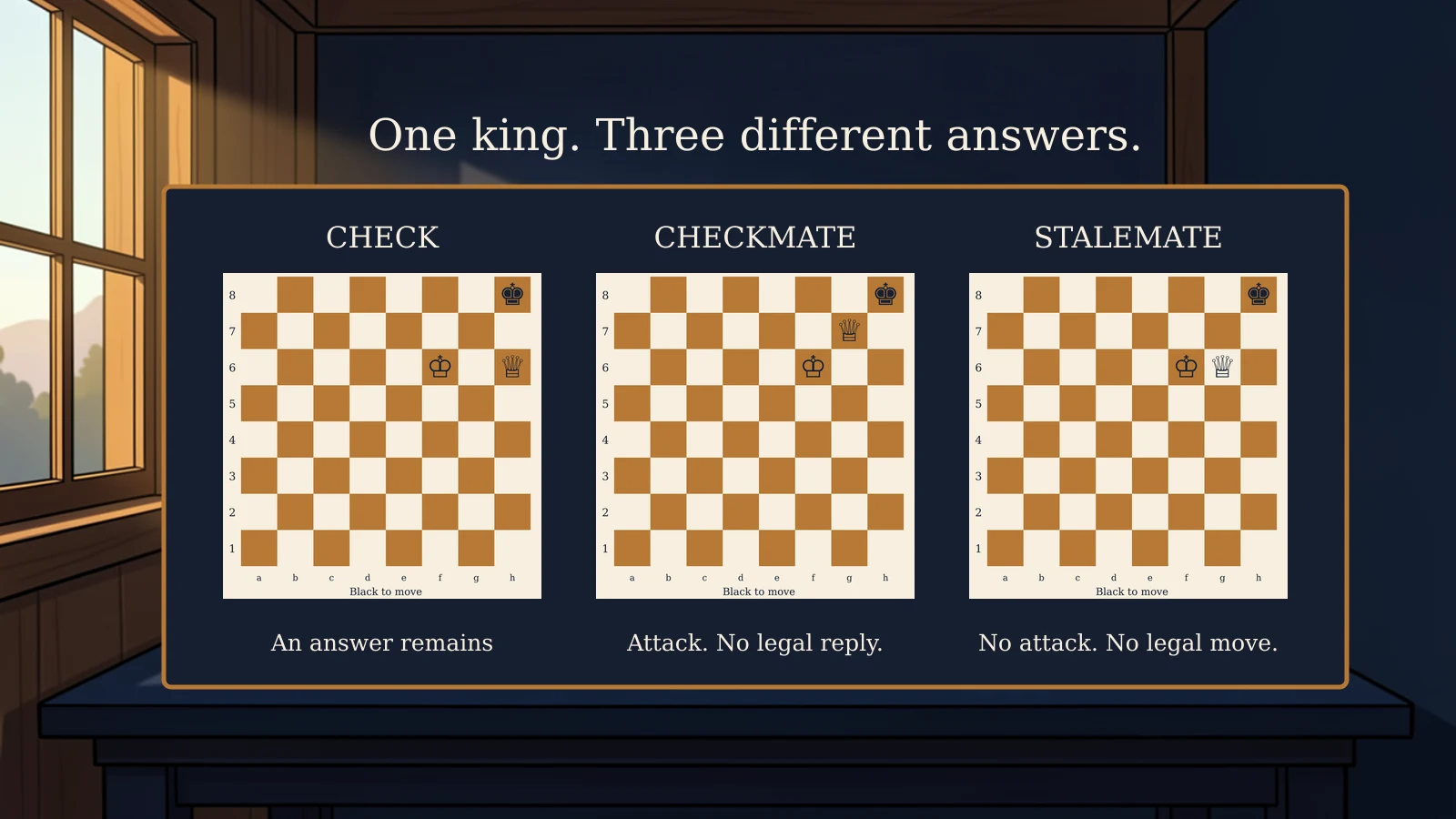
Learn the difference between check, checkmate and stalemate with three exact positions, legal replies and a short practice check.
Read the story →
Learn the Moves
Rapid vs. Blitz vs. Daily Chess: Which Should Beginners Play?
Start with room to notice threats, not just room to click. Compare per-player clocks and per-move deadlines, then choose a pace you can finish.
Read the story →