
← The Chronicle · Learn the Moves
Check, Checkmate and Stalemate: What Is the Difference?
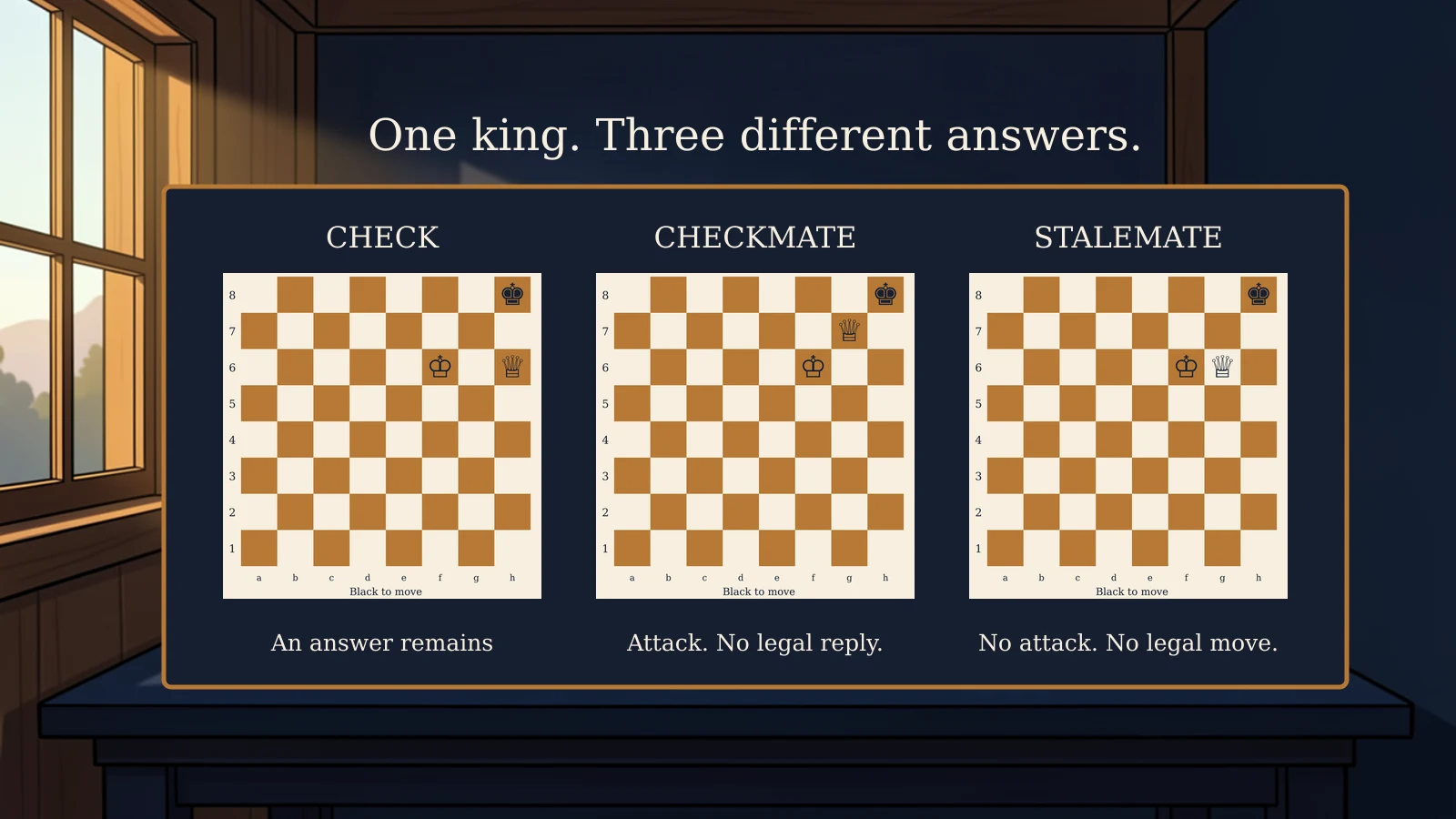
A king with nowhere to go has not necessarily lost. Checkmate requires an attacked king with no legal response; stalemate requires a player with no legal move whose king is not attacked.[1] One is a loss for that player, the other a draw.[1]
Start with two questions: is the king attacked, and does the player to move have a legal move? These distinguish check, checkmate and stalemate, not every other way a game can end.[1]
Start with the player to move
Check means the king is attacked.[1] Checkmate means it is attacked and there is no legal response.[1] Stalemate means the king is not attacked but its player has no legal move at all.[1]
Say whose turn it is before answering. Stalemate concerns the player who has the move, not simply a king that looks trapped.[1] Chess does not allow a player to ignore check or capture the opposing king.[1] A legal checkmating move ends the game immediately, before any king capture.[1]
Check: an answer remains
Being in check is not the same as losing.[1] A legal response must remove the attack without leaving the player's king in check.[1] Depending on the position, that can mean moving the king, capturing the checking piece, or interposing a piece against a long-range attack.[1]
These are possibilities to examine, not three options that are always available. A capture is no answer if it leaves another attack on the king.[1] An empty escape square is no escape if the opponent attacks it.[1] Test the position after the proposed move, not just the piece you want to move.
Position A: one safe square is enough
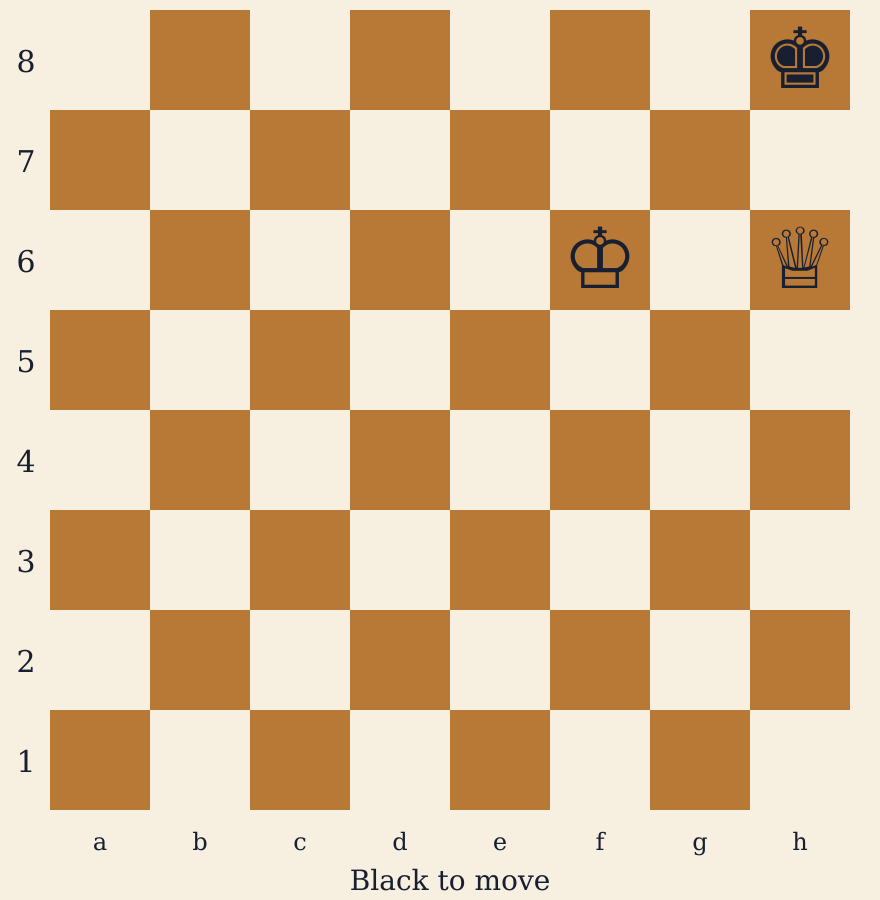
Set up White king f6, White queen h6 and Black king h8, with Black to move and every other square empty. This is a composed teaching position, not a recorded game. All three examples below were tested by full legal-move enumeration with chess.js 1.4.0; the package's chess-validation.json records exact moves and test scope. No retrograde reachability proof is claimed.
The queen attacks h8 along the h-file, making this check under the rules.[1] The legal-move test finds exactly one reply: Kg8, from h8 to g8. Black cannot move to h7 or g7 instead. Because a legal answer remains, this is not checkmate.[1]
Full position for a compatible board editor:
`7k/8/5K1Q/8/8/8/8/8 b - - 0 1`
Read the diagram description
Position A, White at bottom and Black to move: Black king h8, White king f6 and White queen h6; all other squares empty.
View full illustration (opens in a new tab)
This answers only whether Black can respond now, not whether Black can save the game in the long run.
Checkmate: the attack cannot be answered
Checkmate requires both an attack on the king and no legal response.[1] A legal move delivering it ends the game immediately and wins for the player who delivered it.[1] There is no extra turn to remove the defeated king.[1]
Position B: the checking queen is protected
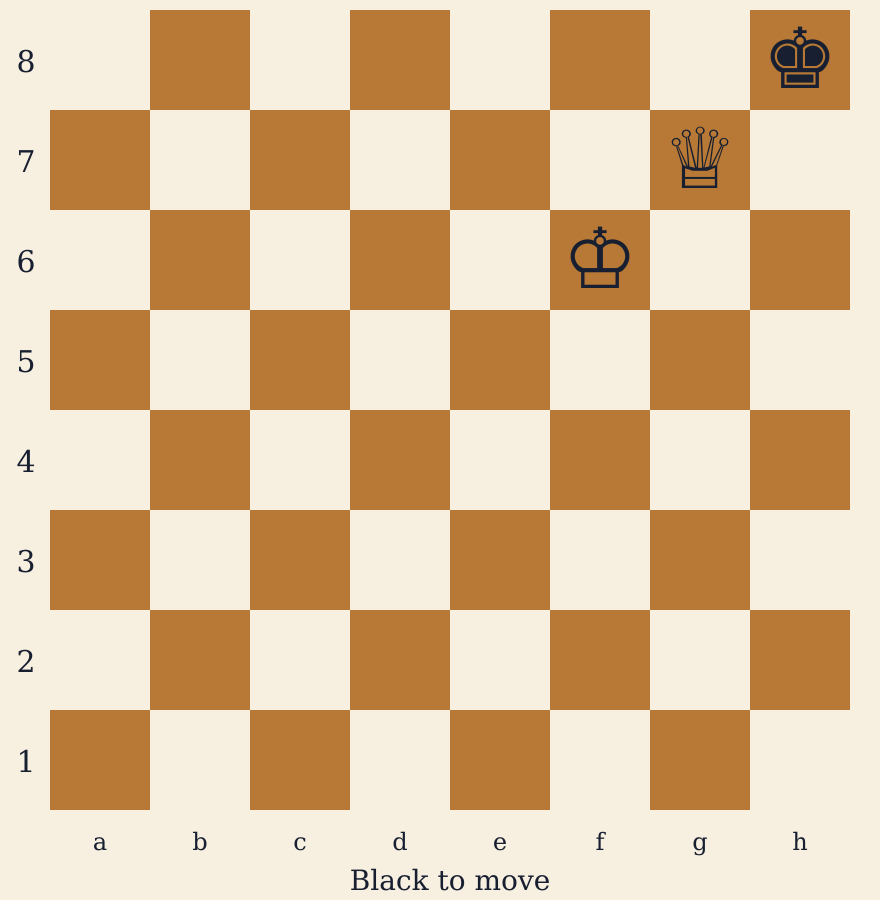
Place White king f6, White queen g7 and Black king h8, with Black to move and every other square empty. This is a separate composed position, not the next move in Position A.
The queen on g7 attacks h8 diagonally and covers g8 and h7, using the queen's rank, file and diagonal movement.[1] Black cannot capture the queen on g7 because White's king on f6 protects it: moving there would put Black's king under attack, which is illegal.[1] Black has no other pieces to capture or block with. The complete enumeration finds no legal moves while Black is in check, so this is checkmate.[1]
`7k/6Q1/5K2/8/8/8/8/8 b - - 0 1`
Read the diagram description
Position B, White at bottom and Black to move: Black king h8, White king f6 and White queen g7; all other squares empty.
View full illustration (opens in a new tab)
Explain the failed replies rather than only naming the result. Could the king move, could the checking piece be captured legally, or could the attack be blocked? Any proposed reply that leaves the king attacked is illegal.[1]
Stalemate: no move, but no attack
Stalemate is a draw, not a win for the player with more material.[1] It occurs when the player to move has no legal move and their king is not in check.[1] It ends the game immediately; the player does not pass and wait for another turn.[1]
Position C: a different queen square changes the result
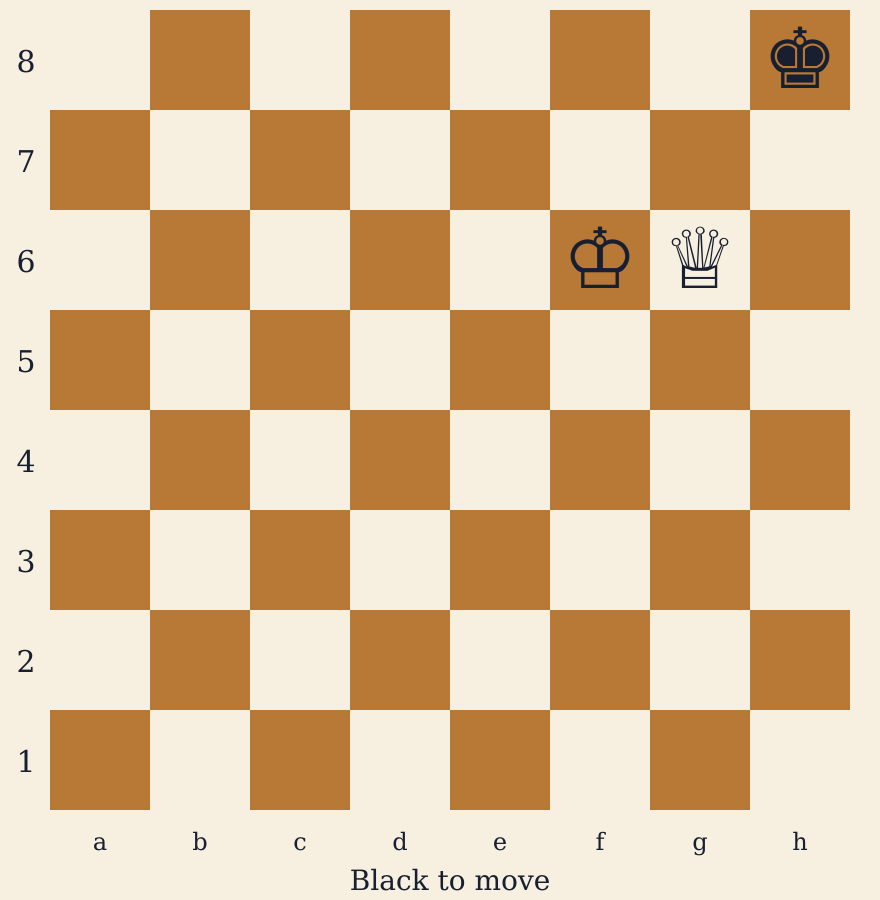
Place White king f6, White queen g6 and Black king h8, with Black to move and every other square empty. This is another independent composed position.
The queen does not attack h8 but covers g8 along the g-file, g7 along that file and h7 diagonally. Those are all the black king's adjacent squares on the board, and Black has no other pieces. The legal-move test returns no moves and no check: the definition of stalemate.[1]
`7k/8/5KQ1/8/8/8/8/8 b - - 0 1`
Read the diagram description
Position C, White at bottom and Black to move: Black king h8, White king f6 and White queen g6; all other squares empty.
View full illustration (opens in a new tab)
Compare B and C carefully. Both leave Black without a legal move; only B attacks the king. That difference makes B checkmate and C a draw.[1]
Do not check only the king's escape squares
These examples deliberately give Black only a king. In a fuller position, a trapped king alone does not establish stalemate.[1] If its player can legally move a different piece or pawn, the “no legal move” condition is not satisfied.[1]
An attacked king may have no king move but still be saved by a move of another piece.[1] The reply must actually resolve the check; an unrelated move elsewhere does not count.[1] Look at all the player's legal replies, not just the king's destinations.
A short practice check
Cover the explanations and reconstruct the three positions on a physical board or in a compatible editor. Keep White's king on f6 and Black's king on h8, with Black to move; try White's queen on h6, g7 and g6, one position at a time.
Ask whether h8 is attacked and whether Black has a legal move before naming each result. Then compare with the tested examples: h6 allows Kg8, g7 gives checkmate, and g6 gives stalemate. Stop after you can explain the difference to another person.
Stalemate is not the only draw.[1] FIDE separately defines a dead position, where neither player can checkmate through any series of legal moves.[1] Do not call every drawn game a stalemate or assume that every position without mate or stalemate must continue.[1]
For a separate question—how much thinking time to give yourself—see Rapid, Blitz and Daily Chess. Here the task is smaller: distinguish an attack that can be answered, one that cannot, and a player with no legal move whose king is not attacked.
Sources
Related stories
Learn the Moves
Rapid vs. Blitz vs. Daily Chess: Which Should Beginners Play?
Start with room to notice threats, not just room to click. Compare per-player clocks and per-move deadlines, then choose a pace you can finish.
Read the story →