
← The Chronicle · Learn the Moves
How to Read Chess Notation: SAN Moves and PGN Games
Chess notation lets you turn a line of text back into moves on a board[2]. SAN, or Standard Algebraic Notation, names individual moves; PGN, or Portable Game Notation, packages a game with descriptive tags, move text and a result marker.[2]
Start with this reading pattern: piece, any necessary starting-square clue, capture sign, destination, promotion, check or mate[2]. Not every move needs every part: Nf3 is a knight move to f3, while exd6 is a pawn capture from the e-file onto d6.[2]
This guide uses English-letter SAN as specified for PGN[1] [2]. A printed scoresheet may follow different algebraic conventions: FIDE's notation appendix allows national piece initials, prints castling with zeros, and gives promotion examples without an equals sign[1] [2]. Those differences are not a reason to change the moves; for a portable PGN, use its specified spellings.[1] [2]
Find the destination square first
A square name combines its file, a lowercase letter from a to h, with its rank, a number from 1 to 8[1]. With White at the bottom, a1 is the bottom-left square and h8 is the top-right; turning the board around does not rename its squares.[1]
In English SAN, K means king, Q queen, R rook, B bishop and N knight[1] [2]. A pawn move has no initial piece letter: write e4, not Pe4[1] [2]. Capitalization matters: B is a bishop, but lowercase b can name the b-file.[1] [2]
The destination usually does most of the work[2]. Nf3 says that a knight lands on f3; it does not automatically say the knight started on g1[2]. You identify the starting piece from the current position, with an extra clue added when more than one legal mover could fit.[2]
Try reading moves aloud before moving anything: “knight to f3,” “bishop takes c6,” “pawn from d takes c6.” Then update the board after each move rather than trying to decode a whole row in your head.
Captures: what the x does and does not tell you
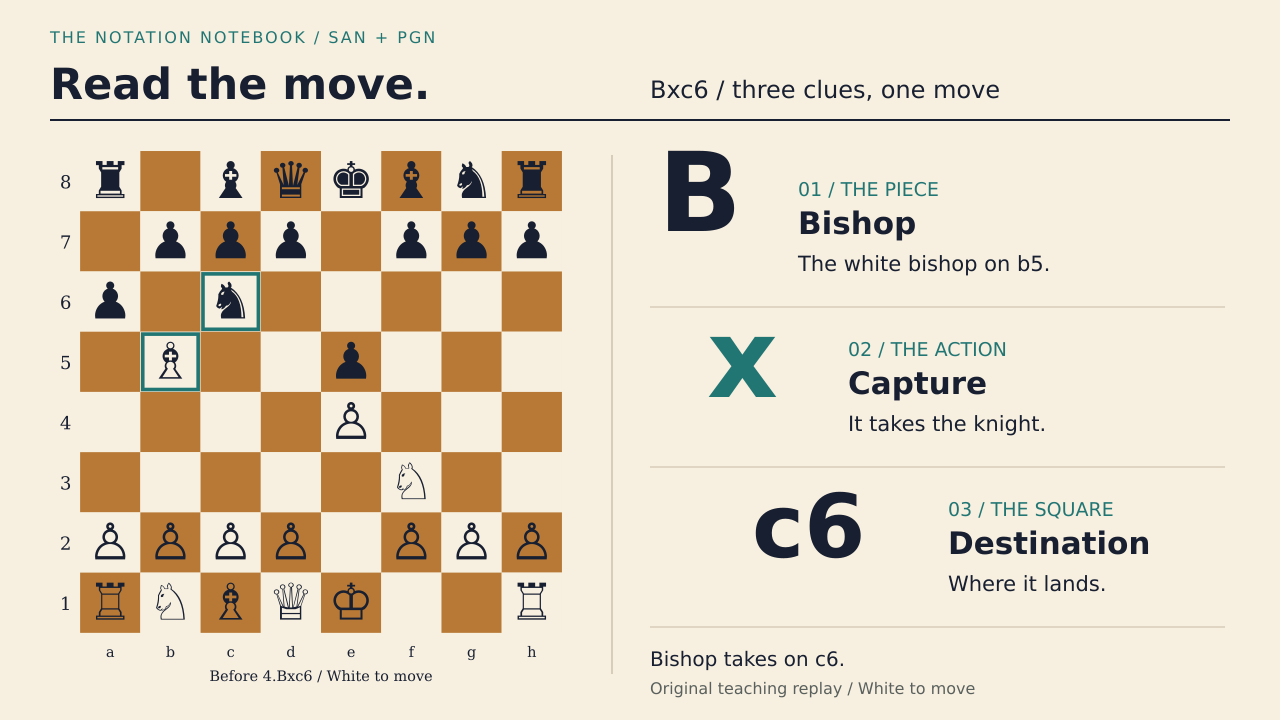
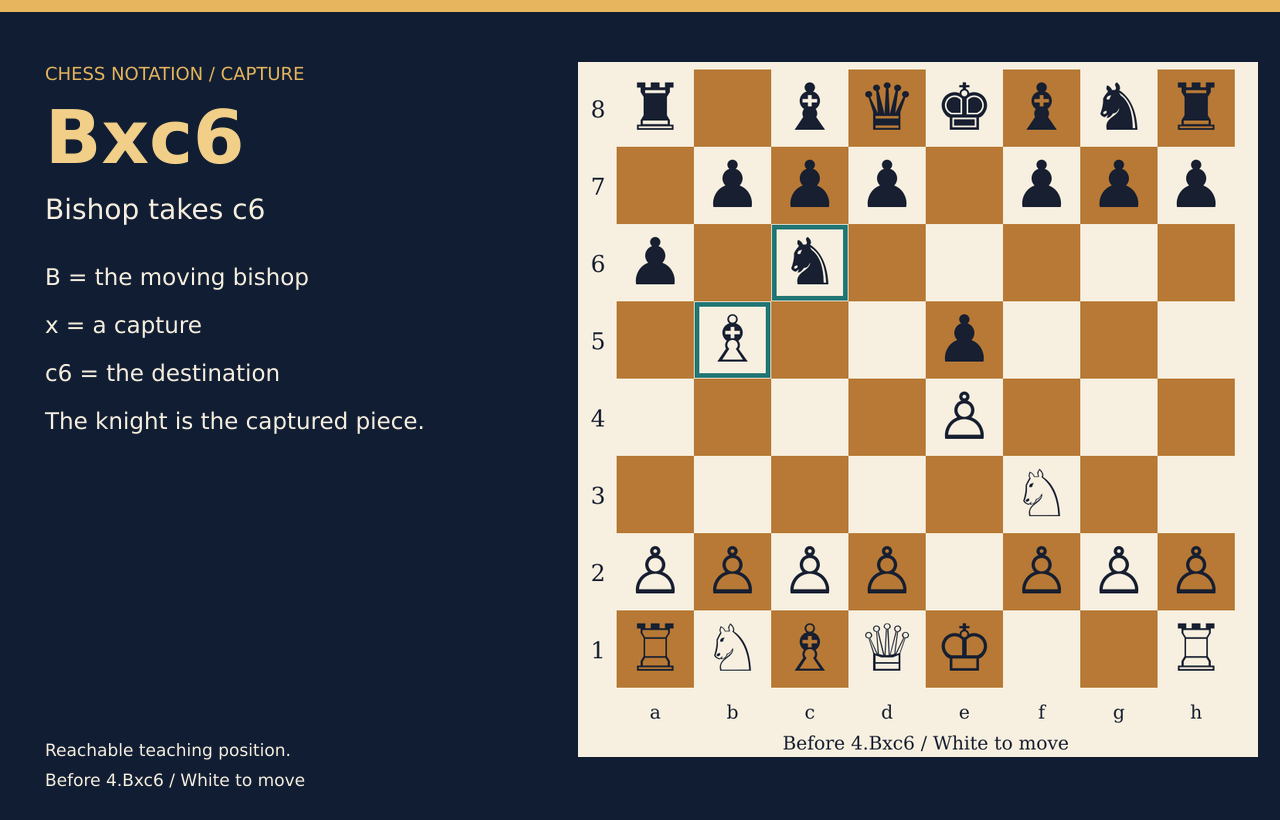
For a piece capture, x comes before the destination: Bxc6 means a bishop captures on c6[2]. The notation names the moving piece, not the captured one; you must look at the position to discover what was taken.[2]
A pawn capture also gives the pawn's starting file[2]. In dxc6, the capturing pawn comes from the d-file and lands on c6[2]. It is not a bishop move and it does not mean “the d-piece was captured.”[2]
Here is a legal sequence from the normal starting position: 1. e4 e5 2. Nf3 Nc6 3. Bb5 a6 4. Bxc6 dxc6. White's bishop travels from f1 to b5, then captures Black's knight on c6; Black's d7-pawn recaptures that bishop on c6.
En passant keeps the same SAN capture pattern. After 1. e4 a6 2. e5 d5, White can play 3. exd6: the e5-pawn lands on d6 and the black pawn on d5 is removed[1] [2]. Canonical PGN SAN adds no separate e.p. token, although FIDE's scoresheet notation permits that explanatory suffix.[1] [2]
View full illustration (opens in a new tab)
When two pieces could make the move
Disambiguation answers “which one?” It considers pieces of the same type that can legally move to the same destination, not every piece that geometrically attacks that square[2]. In PGN SAN, add the starting file if that distinguishes the mover; otherwise add its starting rank; if neither alone is enough, add the full starting square.[2]
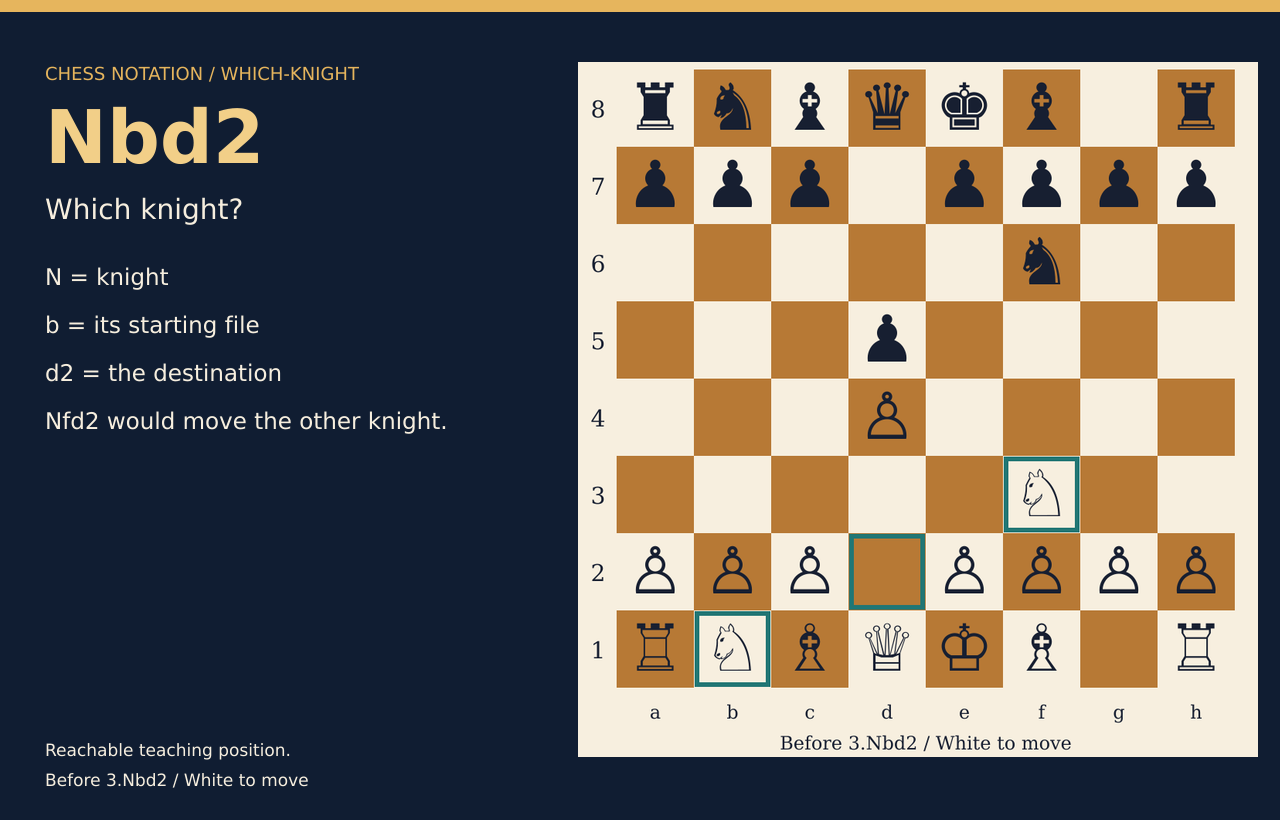
After 1. d4 d5 2. Nf3 Nf6, both white knights can legally reach d2. 3. Nbd2 selects the knight from b1; the other possible move is Nfd2, from f3. The b is a starting-file clue, while d2 remains the destination.
View full illustration (opens in a new tab)
For a rank example, set up White king a1 and knights g1 and g5, Black king a8, White to move. Both knights can reach f3, so the lower knight's move is N1f3 and the upper knight's move is N5f3. These are composed teaching positions, not moves attributed to a historical game.
The rare full-square case needs a little more space. Set up White king h1 and queens b1, b3 and f1, Black king h8, White to move. All three queens can reach d3: the queen on b1 needs Qb1d3, because Qbd3 would not distinguish it from b3 and Q1d3 would not distinguish it from f1.
A pinned piece can change the spelling[2]. With White king e1, knights c3 and g1, Black king e8 and bishop b4, White to move, the c3-knight cannot legally leave its king exposed on the b4–e1 diagonal[2]. The g1-knight's move is simply Ne2, not Nge2, because there is only one legal knight move to e2.[2]
If the disambiguated move is a capture, keep the starting clue before x[2]. The construction is piece, clue, x, destination; checking status does not remove the need to identify the correct mover.[2]
Castling, promotion, check and mate
In PGN SAN, O-O means kingside castling and O-O-O means queenside castling, using capital letter O, not digit zero[2]. Each token records one king-and-rook move, not two separate moves[2]. Our replay below includes legal White kingside castling; the separate line 1. d4 d5 2. Nc3 Nc6 3. Bf4 Bf5 4. Qd2 Qd7 5. O-O-O O-O-O gives legal queenside castling by both players.[2]
A promotion adds = and the chosen new piece: queen, rook, bishop or knight[2]. In a composed position with White king h1 and pawn a7, Black king h8, White to move, a8=Q+ promotes to a queen and gives check, while a8=N promotes to a knight without check[2]. Promotion is a choice, not an automatic requirement to take a queen.[2]
A capture and promotion can appear together. With White king a1 and pawn g7, Black king a8 and rook h8, White to move, gxh8=Q+ captures the rook on h8, promotes the pawn to a queen and checks the king along the eighth rank.
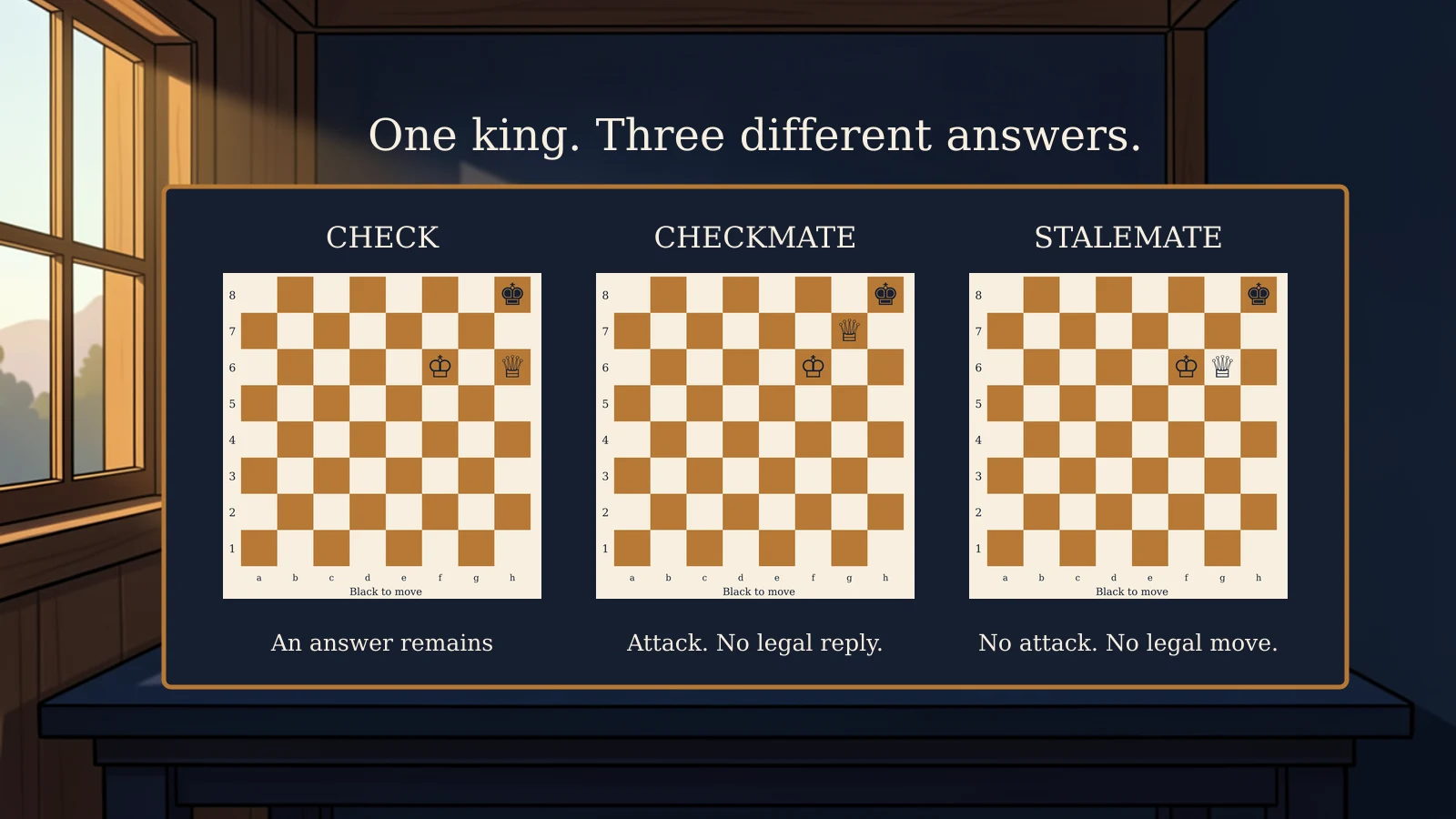
A final + means check; # means checkmate in canonical PGN SAN[1] [2]. Neither sign means that a king was captured[1] [2]. For the distinction between an attacked king, mate and a draw without check, use our check, checkmate and stalemate guide.[1] [2]
For a short legal mate example, replay 1. f3 e5 2. g4 Qh4#. Black's queen moves from d8 to h4 and checks along h4–g3–f2–e1; White has no legal reply. The # describes the board position, while the separate game result is 0-1.
Do not read ! or ? as rules about check or legality[2]. They are assessments of a move, and PGN export represents such annotations with numeric annotation glyphs such as $1 for ! and $2 for ?; they are different from the objective + and # suffixes.[2]
Read a whole PGN, not just its moves
A PGN begins with bracketed tag pairs[2]. The standard Seven Tag Roster is Event, Site, Date, Round, White, Black, Result; a blank line separates these tags from the movetext in export format[2]. The example below is an invented teaching sequence, not a claimed tournament record; question marks avoid inventing a location or game date.[2]
[Event "Checkered Crown composed notation exercise"] [Site "?"] [Date "????.??.??"] [Round "-"] [White "White demonstration"] [Black "Black demonstration"] [Result "*"]
- e4 e5 2. Nf3 Nc6 3. Bb5 a6 4. Bxc6 dxc6 5. O-O Bd6
- d4 exd4 7. Qxd4 *
Read each numbered pair as White's move followed by Black's: 4. Bxc6 dxc6 contains two turns[2]. When a fragment begins with Black's turn, three dots identify that side, as in 4...dxc6; the dots are not another move.[2]
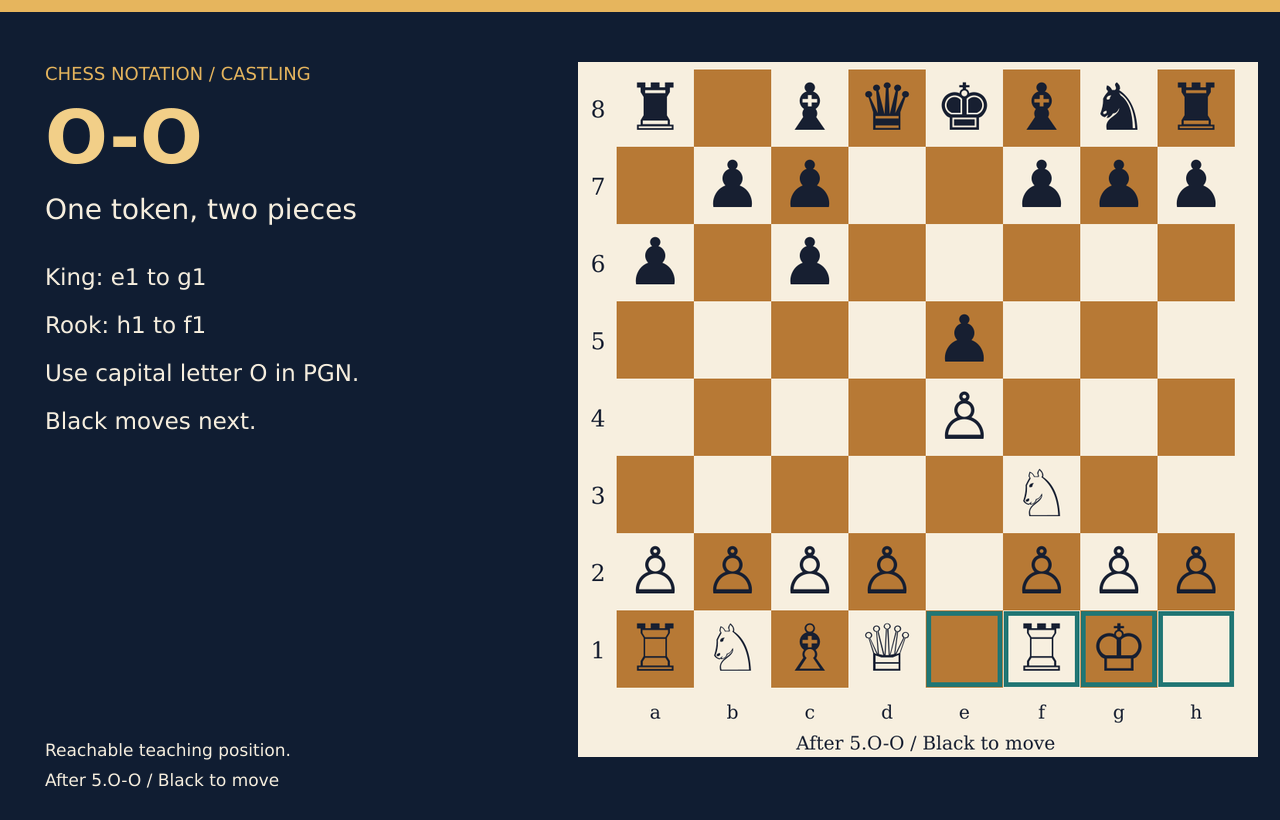
At 5. O-O, White's king moves from e1 to g1 and the rook from h1 to f1. At 6...exd4, Black's pawn from e5 captures the white pawn on d4. At 7. Qxd4, White's queen from d1 recaptures that pawn. Stop there: this exercise has not reached checkmate or an asserted draw.
View full illustration (opens in a new tab)
The terminal marker * means a game in progress, an unknown result or an abandoned game, not a draw[2]. The other markers are 1-0 for a White win, 0-1 for a Black win and 1/2-1/2 for a draw[2]. The marker at the end must match the Result tag; a win marker by itself does not tell you whether the cause was checkmate, resignation or something else.[2]
PGN can also contain comments in braces, such as {A teaching note}, and alternative lines in parentheses[2]. A parenthesized variation branches from the position before the move immediately preceding it; do not play its moves as though they all continue the main line[2]. This lesson's copyable example deliberately leaves comments and variations out.[2]
A game that starts from a custom position needs its starting-position information, not just a list of SAN moves[2]. PGN uses SetUp "1" together with a FEN tag for a nonstandard start; FEN describes a position, whereas PGN can preserve the sequence of moves[2]. The sparse promotion and disambiguation setups above are separate exercises, not continuations of the main replay.[2]
A small replay exercise
Set up the normal starting position and replay the PGN one turn at a time. Before each capture, point to the piece that moves and the piece that will leave the board. After castling, check both the king and rook squares. Finally, cover the answer below and name White's queen square, Black's c-pawn square and whose turn comes next.
Answer: after 7. Qxd4, White's queen is on d4, Black's original c-pawn is still on c7, and Black moves next. The black pawn on c6 came from d7; following identities through captures matters more than remembering where a piece started the game.
If a replay stops making sense, return to the last position you could verify[2]. Check the side to move, the destination square, any capture and any starting-file or starting-rank clue[2]. For a custom-position PGN, check the starting FEN before trying to repair the move text[2]. SAN is position-dependent; one isolated token cannot reconstruct an entire board.[2]
For a family practice session, take turns being the reader and the board operator. Replay the same short line twice, then explain one capture without looking at the answer. The immediate goal is a saved game you can follow accurately, not memorizing every rare notation case at once.
Sources
Related stories
Learn the Moves
Check, Checkmate and Stalemate: What Is the Difference?
Learn the difference between check, checkmate and stalemate with three exact positions, legal replies and a short practice check.
Read the story →