
← The Chronicle · History Behind the Story
How Chess Traveled from India to Medieval Europe
The queen has not always been the strongest piece on the board. Beside the king there was once a counselor, and she moved one square diagonally. Set that next to the queen you play today and the game stops looking like an object passed from hand to hand. It looks like a set of agreements that changed every time it crossed a border.
Checkered Crown uses that history as a door. The Road puts real places next to fictional characters and chess lessons. The order of the adventure is game order, not a history textbook.
India
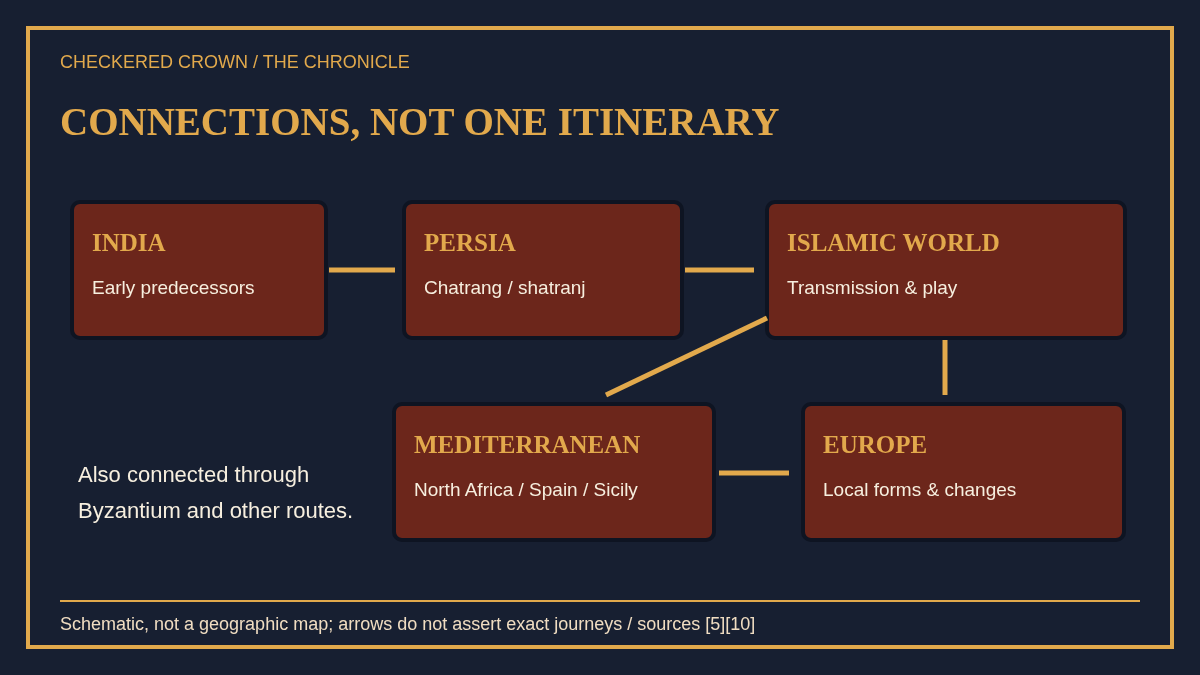
Chess historians tie the modern game to chaturanga, an Indian predecessor already being played by the seventh century. Two things in it still look like chess. The pieces did not all move the same way, and the game turned on one piece, the ancestor of the king. The British Museum puts the beginning in India in the 600s. That is a broad date, not the name of an inventor. Other old board games used counters and dice. A carved piece is not always a chess piece.
Persia
From India the game moved into Persia. The form played across the Islamic world is called shatranj. It was not modern chess with odd names. The counselor stepped one square on the diagonal. The elephant, which became the bishop, jumped two squares on the diagonal. How you won, and how some pieces stood at the start, changed from place to place. A piece's power is an agreement. Change the agreement and the plans that work change with it.
Into Europe
Muslim players carried the game to North Africa, Sicily, and Spain by the tenth century. Byzantium was another road in. There was no single traveler with the first set. Once a player knew it, they could teach it. A board did not have to carry its own history for the rules to spread.
View full illustration (opens in a new tab)
Lewis
The Lewis Chessmen were found on the Isle of Lewis, in Scotland. Kings, queens, bishops, and mounted warriors, carved as people from a court. A common theory has them made in Trondheim, in Norway, around 1150 to 1200. The British Museum treats that as a theory. Who owned them, and why they were on Lewis, is still open. Found in Scotland is not the same as made in Scotland. A queen in the set is not proof she already moved like the queen you play.
The faster game
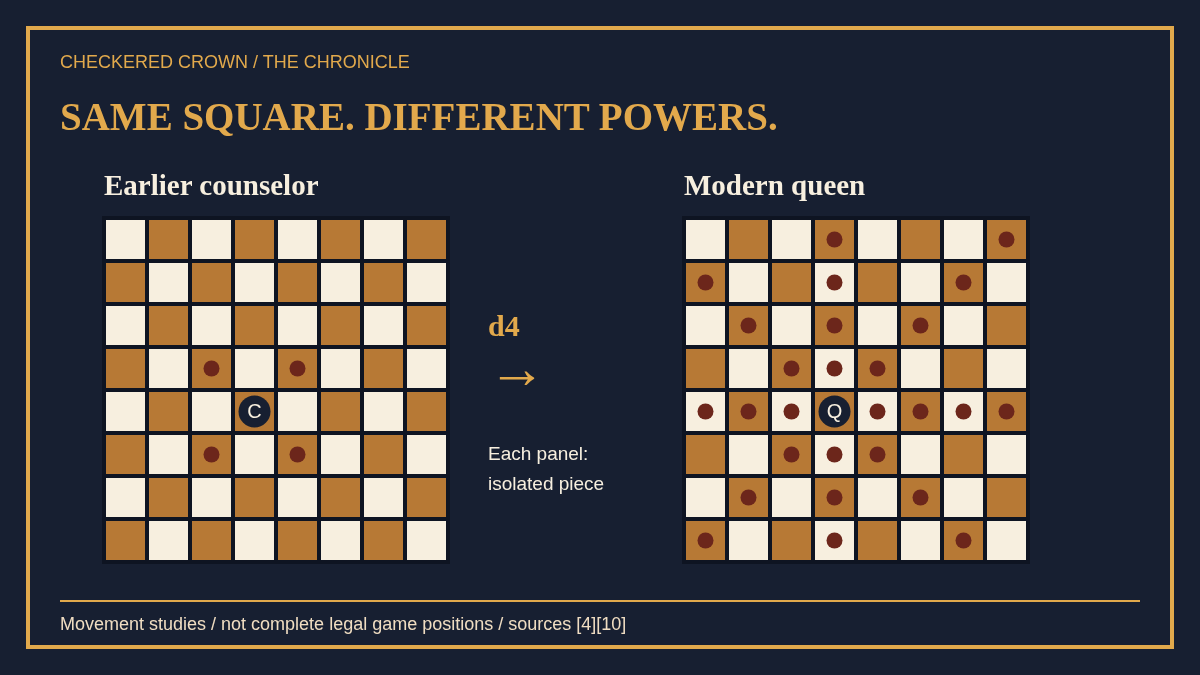
After about 1475 the queen and the bishop changed, and the new moves caught on. The counselor's one-square step became the queen's long reach on rank, file, and diagonal. The elephant's jump became the bishop's long diagonal. A pawn that crossed the board mattered more, because of what it could become. Mate got easier to force. Castling and en passant took longer to settle, and they did not settle everywhere at once. The dates invite a story about one famous queen causing the change. The records show the rule. They do not name the cause.
Read the diagram description
Two isolated movement studies from d4, with no other pieces or blocking pieces. Historical counselor destinations: c3, c5, e3, e5. Modern queen destinations: a1, a4, a7, b2, b4, b6, c3, c4, c5, d1, d2, d3, d5, d6, d7, d8, e3, e4, e5, f2, f4, f6, g1, g4, g7, h4, h8.
View full illustration (opens in a new tab)
What held
Different powers, and a king the game cannot afford to lose. A player today can see the family. A player in 1100 would not know every move on a modern board. Chess did not arrive in Europe finished. It arrived, got local names, and kept changing.
Try the ideas yourself: Explore The Road.
Sources
Related stories
Learn the Moves
Rapid vs. Blitz vs. Daily Chess: Which Should Beginners Play?
Start with room to notice threats, not just room to click. Compare per-player clocks and per-move deadlines, then choose a pace you can finish.
Read the story →