
← The Chronicle · History Behind the Story
The Gunpowder Plot of 1605: What Really Happened?
A king was due upstairs. Gunpowder was waiting below. On 5 November 1605, the State Opening of Parliament was meant to put James I, the Lords, and the Commons in one chamber. Under that chamber, a rented storeroom was already full of powder. The plot failed the night before the ceremony.
Checkered Crown's London 1605 adventure uses fictional chess-piece characters in historical roles. The dialogue is invented. This is the record.
Why Parliament
England in 1605 tied religion to loyalty. Catholics lived under restrictions, and some hoped James would loosen them after he became king in 1603. He did not. That disappointment is the background. It is not an excuse. A small group chose to kill the people gathered for the opening. They were not speaking for every Catholic in England.
Robert Catesby proposed the opening as the target. The king, the Lords, and the Commons would be in the same room. The conspirators meant to kill them, including the monarch, and use the break to change the government. They also hoped to raise support in the Midlands and seize James's daughter, Princess Elizabeth, who would not be at the ceremony. What would replace the government was not worked out. Destroying it was not the same as having another one ready.
Catesby, not Fawkes
Catesby organized it. Guy Fawkes joined a plot that already had a leader. He had soldiered abroad and knew explosives, so he was the man left with the powder and the fuse. Thomas Percy helped the group get into Parliament. They rented the undercroft directly beneath the House of Lords.
The room
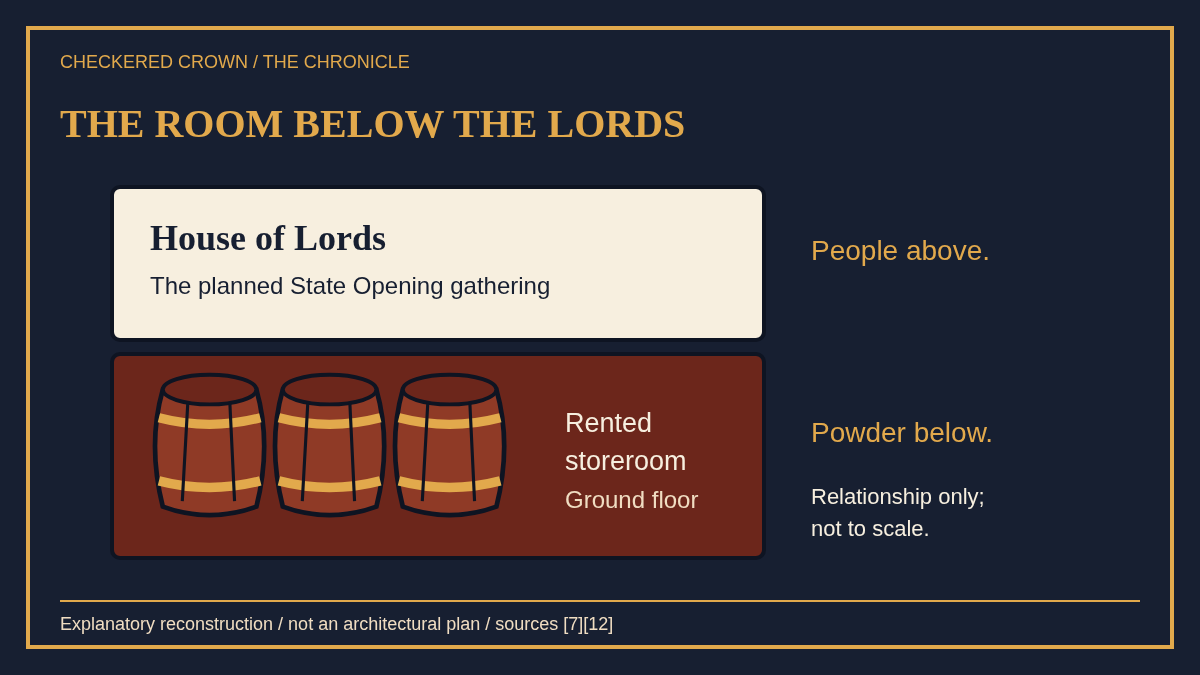
Forget the skyline of today's Parliament. In 1605 the Palace of Westminster was a jumble of medieval buildings. The place called Fawkes's cellar was a ground-floor storeroom under the Lords. The conspirators rented it and moved the powder in. Parliament and Historic Royal Palaces give the figure as thirty-six barrels. No tunnel is required. The powder was found in a room they paid for.
View full illustration (opens in a new tab)
The night
Fawkes stayed. The others left London. If anyone asked, he was John Johnson, a servant. The room was meant to stay quiet until the fifth.
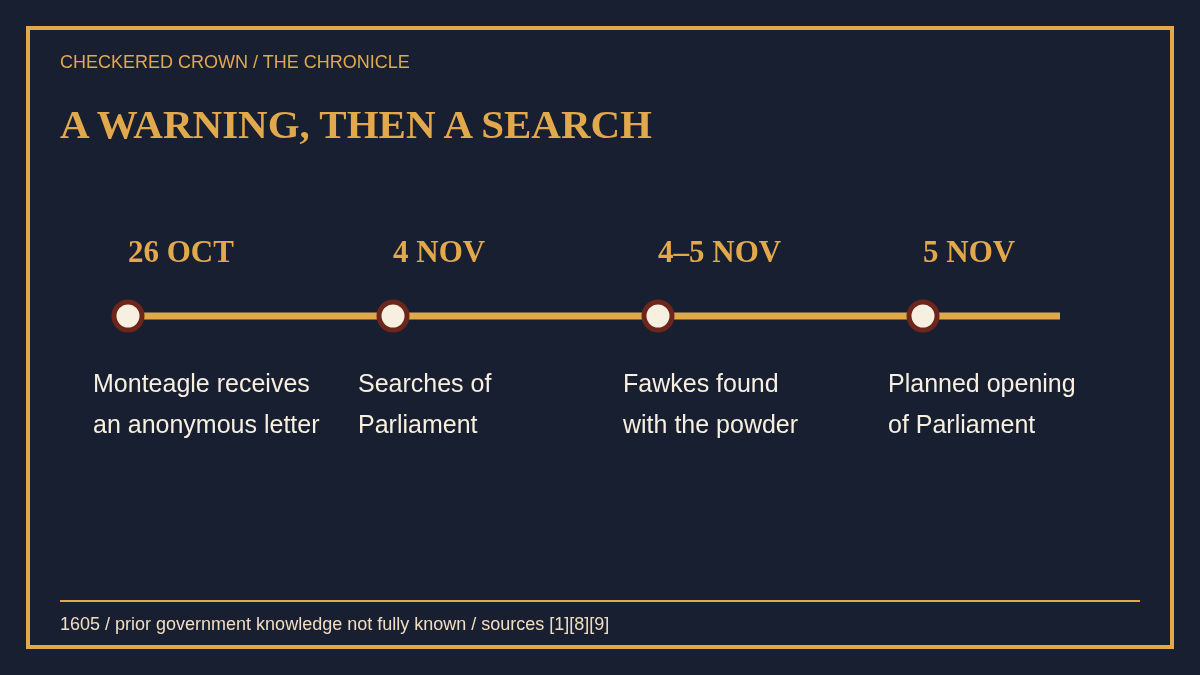
On 26 October, Lord Monteagle received an unsigned letter telling him to stay away from Parliament. One line in the National Archives transcript warns that "they shall receive a terrible blow this Parliament." Monteagle took it to Robert Cecil, Earl of Salisbury. Francis Tresham has long been proposed as the writer. A proposal is not a solved name. The government already had inklings of a plot. The letter is part of how the search happened. It is not proof that the warning alone caused it.
View full illustration (opens in a new tab)
A first search of Parliament passed through on 4 November. Around midnight, Sir Thomas Knyvett came back, with Edmund Doubleday among the men who found and challenged Fawkes. The barrels were still closed. Fawkes was still there, still using the name John Johnson. He was arrested before the opening, not after a blast. The date sits on the night of 4–5 November. Institutional accounts place the discovery late on the fourth or in the early hours of the fifth.
After
The others ran. On 8 November, Catesby, Thomas Percy, and John and Christopher Wright were shot dead when the fugitives were confronted at Holbeche House. Fawkes was imprisoned in the Tower and tortured. The king's authorization for that torture is part of the record. Surviving conspirators were tried for treason in January 1606. Fawkes was executed on 31 January. The group had planned to kill the people gathered for the opening. The state's punishment was brutal too.
5 November became an annual day of thanksgiving for the failure, under an Act of Parliament. Bonfires and fireworks are what remain of that commemoration. The day remembers a plot that did not happen.
What holds
Catesby organized it. Fawkes was found with the powder. The hiding place was a rented room under the Lords. Monteagle passed an unsigned warning to Cecil. The letter's author is unknown. Those are the edges of the record.
For the man whose name stuck to the anniversary, read Who Was Guy Fawkes?
Follow the story: Get premiere updates. Parents can sign up for younger readers. Email updates are for ages 13 and over.
Sources
- Frequently Asked Questions: The Gunpowder Plot - UK Parliament
- The Gunpowder Plot - The National Archives
- Guy Fawkes and the Gunpowder Plot | Tower of London | Historic Royal Palaces
- Parliament in 1605 - UK Parliament
- Parliament receives a tip-off - UK Parliament
- Who captured Guy Fawkes? - UK Parliament
- The Plot - UK Parliament
Related stories
History Behind the Story
Who Was Guy Fawkes, and Why Do We Remember November 5?
The man caught with the powder was not the organizer. Discover who he was, what happened to him and why November 5 became an anniversary.
Read the story →