
← The Chronicle · History Behind the Story
School or Apprenticeship? Children’s Lives in Tudor and Stuart England
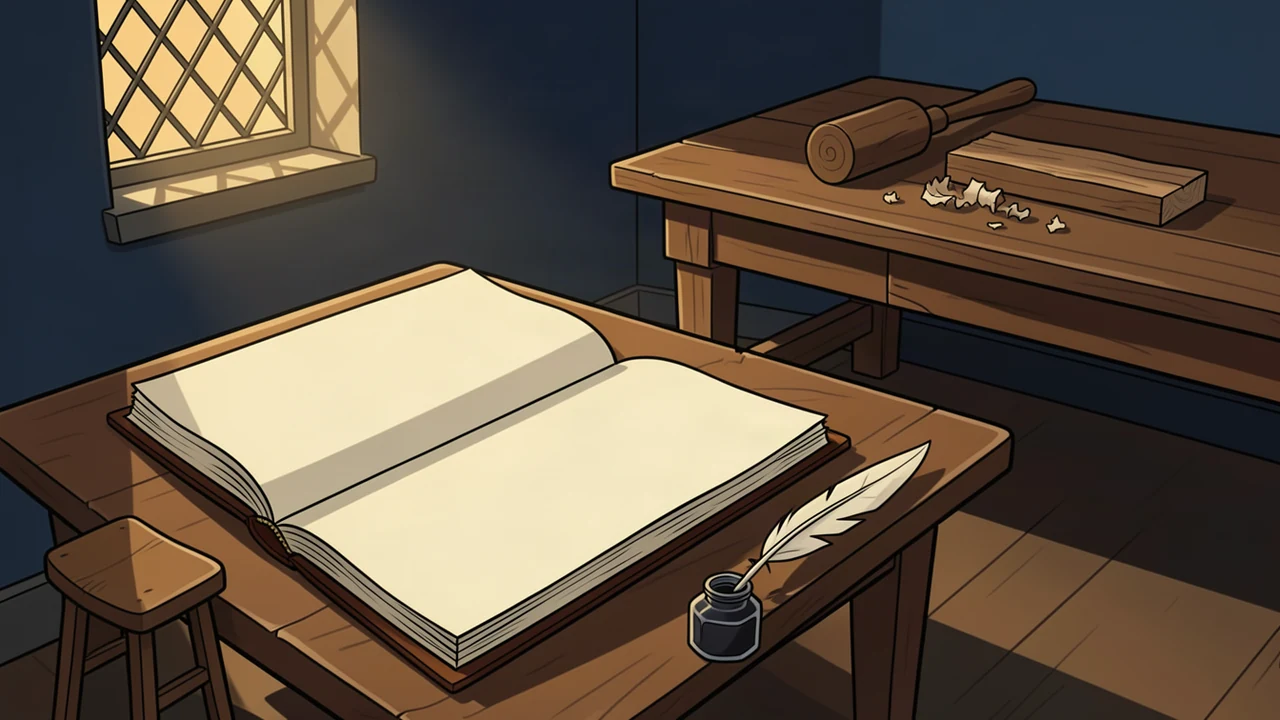
A classroom and a workshop were not always competing destinations. In Marlow, a school founded in 1624 provided for poor boys to learn reading, writing and accounts, then receive money towards an apprenticeship after two years.[1] That local arrangement unsettles a familiar picture of the past: some children’s route to work could include school rather than exclude it.[1]
But there was no single childhood waiting behind the school door. A landowner’s child taught by a private tutor, a girl learning at home and a young apprentice living with a craft worker had different opportunities.[1][2] To understand education in Tudor and Stuart England, ask not simply whether a child attended school, but who taught them, what they learned and who controlled the next step.
Who could go to school?
The Buckinghamshire heritage account describes limited places at its sixteenth-century boys’ schools, with reading, writing, arithmetic and Latin among the subjects taught.[1] It also describes mostly free education and admission for academically able poor boys: school was not exclusively a purchase for the wealthy.[1] Yet free tuition and a place for every child are different things. The same account stresses that many children worked in fields or towns rather than attending school.[1]
Keep that local scale in view. Buckinghamshire examples show what particular foundations offered; they cannot supply an attendance rate for the whole country. A rule about admission tells us who an institution intended to teach, not how many families could actually use it.
Gender imposed another barrier. Historian Jackie Eales explains that girls were excluded from grammar schools and the universities of Oxford and Cambridge, while formal girls’ schools were scarce in sixteenth-century England.[2] That does not mean girls were incapable of learning, or that no girl received an education. It means important institutions were closed to them.[2]
Nor did provision stand still across the period. Eales describes more evidence of girls’ schools under James I and further foundations during the seventeenth century, principally serving daughters of the gentry, merchants and professional families.[2] A school available late in that century should not be imagined into every town a hundred years earlier.
View full illustration (opens in a new tab)
Home could be a place of learning
For wealthy families, home teaching could involve substantial resources.[1][2] Buckinghamshire’s heritage account describes tutors teaching the children of rich landowners subjects including reading, writing, mathematics, Latin, Greek, French and rhetoric.[1] Eales likewise identifies parents, male tutors and female governesses as educators of higher-status girls.[2]
A useful distinction is between *where* a lesson happened and *how extensive* it was. Learning at home did not necessarily mean a little informal instruction, just as attending school did not guarantee the same curriculum everywhere. Elite home education could be extensive; access to it depended on circumstances unavailable to many other children.[1][2]
Eales also traces learning beyond elite households. She describes the role of clerical families in girls’ education, including reading religious works and, for wives and daughters, activities such as recording sermons and writing prayers.[2] Some clergy wives supported teachers for poor children or taught children themselves.[2] These examples make the home more than a private alternative to school: particular households could help spread teaching within their communities.[2]
Religious reading mattered in this account, but it should not become a claim that religion was the only reason anyone learned. Eales also points to economic and social advantages of literacy, including its usefulness at work.[2] Reading, writing and practical calculation could serve different purposes in different lives.[1][2]
What did an apprenticeship involve?
An apprenticeship was more than watching someone work. Gloucestershire Archives describes an indenture as a legal agreement between a master and a child’s parents or guardians, setting terms such as cost and duration.[4] Its guide explains that the master would house, feed and train the child, commonly in return for a payment from the parent.[4]
This helps explain why a workshop could be both a place of learning and a new household.[1][4] Training involved dependence on another adult for necessities as well as instruction.[1][4] It was not simply a modern classroom with different furniture.
Seven years appears frequently in the records, but it is not a safe answer for every agreement.[3][4] The Gloucester registers described by the archive recorded a term usually lasting seven years; a late-Stuart example discussed by London Lives bound a girl to a stocking mender for five.[3][4] Read the agreement before supplying an age, term or promised outcome.
Money could also shape entry. The Buckinghamshire account notes that some apprenticeships cost more than others and that parents often paid for them.[1] Other arrangements involved charity or parish support: Gloucestershire Archives identifies both charitable funding and apprenticeships arranged by overseers of the poor.[4] A parent purchasing training and a parish arranging a placement belong in the same history, but they should not be treated as identical experiences.
Girls, work and a late-Stuart record
Girls could be apprentices too.[1] A concrete example survives in London Lives’ discussion of St Clement Danes parish records from 1688–1694: a girl was legally apprenticed to Anne Briant, a stocking mender, for five years.[3] The example shows both a female apprentice and a woman receiving an apprentice into her occupation.[3]
The parish book also reveals the administrative priorities behind a placement. London Lives explains that its indemnities bound the master to provide for the child so that the parish would face no further expense, while the accompanying indentures set out both parties’ duties.[3] Support and cost control appear together in that description.[3]
What the account does not give us is the girl’s own judgment of her placement. We cannot turn a legal entry into a happy success story, or an account of mistreatment, without further evidence. A promised duty is evidence of an obligation; it is not proof that the obligation was fulfilled.
The source itself needs careful handling, too. Its image caption and explanatory paragraph spell the apprentice’s surname differently.[3] The existence and terms of the example do not require us to settle that discrepancy. Here, leaving her surname unresolved is more accurate than silently choosing a spelling and pretending the evidence agrees.
School and work were not a simple either-or
Return to Marlow. The Buckinghamshire account describes Sir William Borlase’s provision for 24 poor boys to learn reading, writing and accounts, with money towards apprenticeships after two years of schooling.[1] It separately describes provision for 24 girls to learn sewing, spinning and lace-making.[1]
These were not equal courses with different labels. The planned subjects distinguished the children’s expected futures by gender.[1] Yet the boys’ arrangement also joins literacy, calculation and occupational training rather than placing them in separate worlds.[1] It is a particularly useful answer to the question in this article’s title: sometimes the intended sequence was school *and then* apprenticeship.[1]
That is a local foundation’s design, not proof that every pupil completed the course or secured a successful livelihood. Nor should its opportunities erase children whose families relied on their work and who had little access to formal teaching.[1] An example becomes misleading when it is made to stand for everybody.
View full illustration (opens in a new tab)
What surviving records cannot tell us
The evidence is uneven. Gloucestershire Archives warns that apprenticeship records survive very differently from parish to parish, that no comprehensive name index exists and that a desired record may not have survived.[4] Its surviving Gloucester registers begin in 1595, while the listed Tewkesbury material reaches back to 1540.[4] Those are useful local starting points, not a complete list of England’s working children.
The National Archives’ apprenticeship guide also needs to be read with its dates attached. Its stamp-duty books cover 1710–1811; it separately directs researchers towards earlier London livery-company records and local archives.[5] Using the duty books alone would miss the Tudor and seventeenth-century lives at the centre of this article.
Literacy is similarly difficult to count. Eales cautions that a signature does not provide a complete picture of someone’s education and cannot tell us how many people could read but not write.[2] A person absent from school registers might still have learned at home; a person unable to sign a document should not automatically be imagined as unable to read.[2]
The strongest answer is therefore a comparison, not a single typical childhood. Schooling, household teaching and apprenticeship offered different forms of learning, with access shaped by wealth, gender and place.[1][2][4] Ask of each surviving record: whose opportunity does this describe, what did it promise, and whose experience remains out of sight?
Explore more evidence-led stories in the Chronicle.
Sources
- Education (Tudor and Stuart) - Buckinghamshire's Heritage Portal
- To booke and pen: Women, education and literacy in Tudor and Stuart England — Jackie Eales
- Background - Parish Apprenticeship Indentures and Registers (PA) - London Lives
- Apprenticeship records | Gloucestershire Archives
- Apprentices and masters - The National Archives