
← The Chronicle · Learn the Moves
En Passant Explained: The One-Move Window and King-Safety Trap
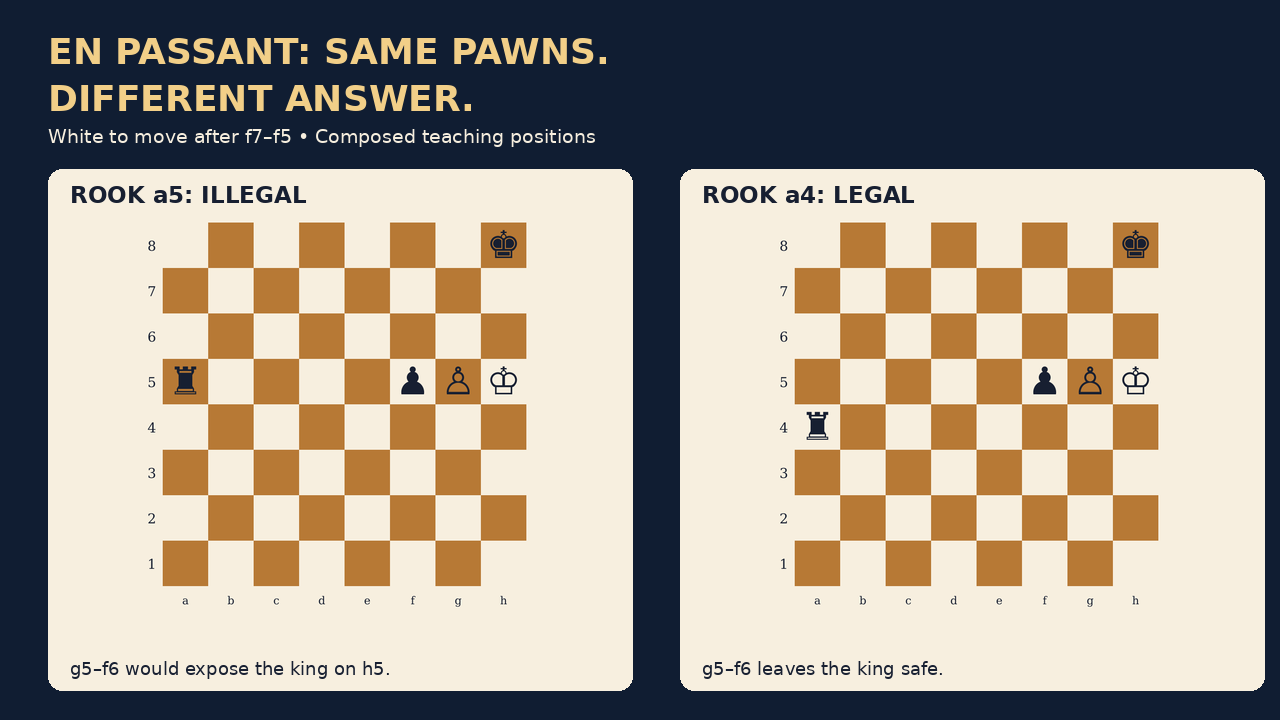
En passant can be illegal even when the pawns are in the right places and the capture is attempted immediately: you may not expose your own king to check.[1] The useful test is to picture the whole resulting board, including the square the captured pawn leaves behind, before deciding whether the capture is legal.[1]
This guide uses the FIDE Laws of Chess for standard over-the-board play, with small composed teaching positions rather than positions attributed to famous games.[1] Start with the ordinary capture, then compare two almost identical boards. The difference is not the pawn's movement: it is the rook's line to the king.
What en passant actually does
Normally, a pawn captures an opposing piece one square diagonally forwards.[1] En passant is the special case where an opposing pawn has just advanced two squares from its original square and finished beside your pawn on the same rank.[1] Your pawn may capture it as though it had advanced only one square, but only on your very next move.[1]
For example, put a White pawn on e5 and imagine Black has just played d7–d5: White may capture from e5 to d6, removing the Black pawn from d5, provided White's king remains safe.[1] The destination is d6, not d5: the capturing pawn moves diagonally forwards, while the captured pawn comes off a different square.[1] That unusual removal is the detail to watch when checking for exposed attacks.[1]
For White, this familiar arrangement has the capturing pawn on the fifth rank; for Black, the corresponding capturing pawn is on the fourth rank.[1] Black's capture works in the opposite direction: after White advances e2–e4 beside a Black pawn on d4, Black may capture d4–e3 immediately if the move is otherwise legal.[1] En passant applies to pawns, not to a knight or bishop that happens to stand beside the pawn that advanced.[1]
The one-move window: now, not later
Try this legal sequence from the normal starting position:
`1. e4 a6 2. e5 d5 3. exd6`
White's final move goes from e5 to d6 and removes the pawn on d5: it uses the immediately preceding two-square advance.[1]
Now reset to the position after `2...d5` and instead play:
`3. Nf3 Nf6`
White can no longer capture that d5-pawn en passant: the immediate opportunity has expired.[1] The pawn's continued presence on d5 does not preserve the right, and moving your own pawn forwards later does not renew that particular opportunity.[1]
A practical memory aid is last move, landing square, king safety. Ask those questions in that order before choosing your move.
The checklist before you capture
First, identify exactly what your opponent just moved: it must be a pawn making a two-square advance from its original square.[1] Next, check that your pawn is beside it, on the same rank and an adjacent file, ready to capture it as though it had advanced one square.[1] Then picture your pawn's diagonal destination and remove the captured pawn from its actual square, not from your destination square.[1] Finally, examine your own king in that resulting position: no piece may make a move that leaves or exposes its king to check.[1]
Timing and king safety are separate requirements.[1] Passing the first test never overrides the second.[1]
The horizontal trap: two pawns leave the line
Use this composed position with White to move:
- White: king h5, pawn g5.
- Black: king h8, rook a5, pawn f5.
- Black's last move: f7–f5.
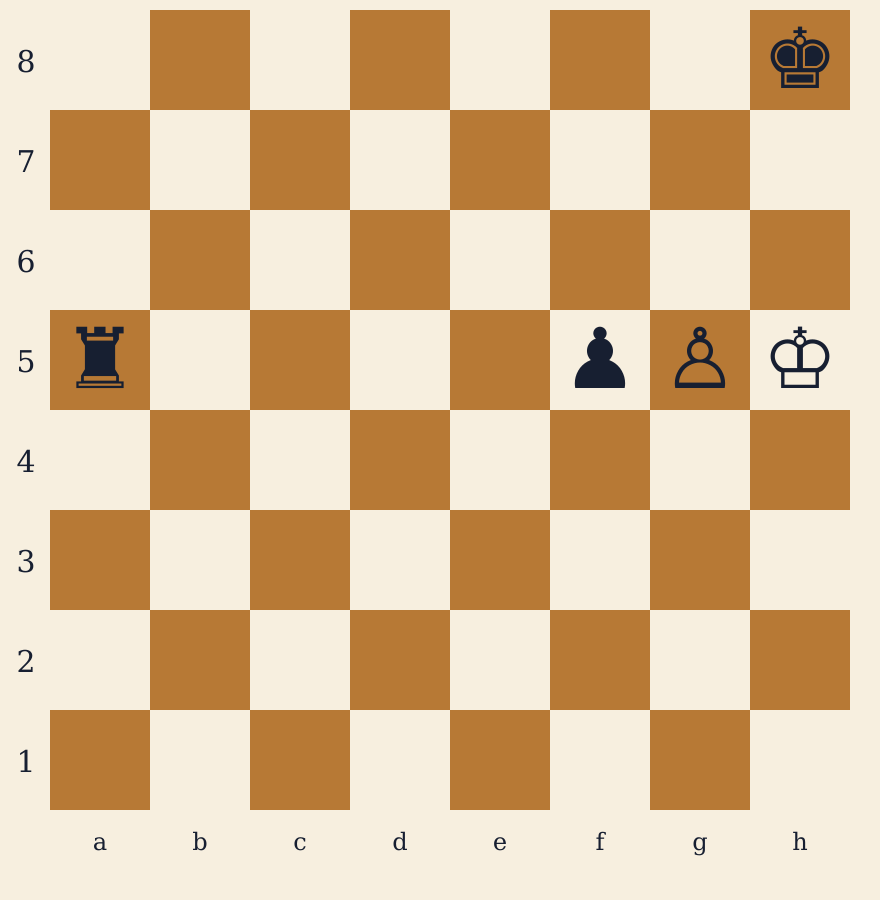
Read the diagram description
Composed board: White king h5 and pawn g5; Black king h8, rook a5 and pawn f5. White to move after f7–f5. Composed teaching position; the rook is on a5.
View full illustration (opens in a new tab)
White would like to play g5–f6 en passant. Before reading the answer, trace the fifth rank from the Black rook to the White king.
The capture is illegal: moving White's pawn off g5 and removing Black's pawn from f5 would clear the rook's route from a5 to h5, exposing White's king to check.[1] The White pawn would finish on f6, which does not block that fifth-rank attack.[1]
The mistake is to inspect only the moving pawn. En passant changes three squares: the capturing pawn's start, its destination and the captured pawn's square.[1] Here, two occupied squares on the king's rank become empty at once, and the result fails the king-safety rule.[1]
White is not already in check in this setup; the proposed capture is forbidden because it would create check against White's own king.[1] There are other legal choices, including g5–g6, so the correct response is to choose a legal move rather than insist on the special capture.[1]
Change the rook's rank: the capture becomes legal
Keep both kings and both pawns in the same places, but put Black's rook on a4 instead of a5. Black has again just played f7–f5, and White has the move.
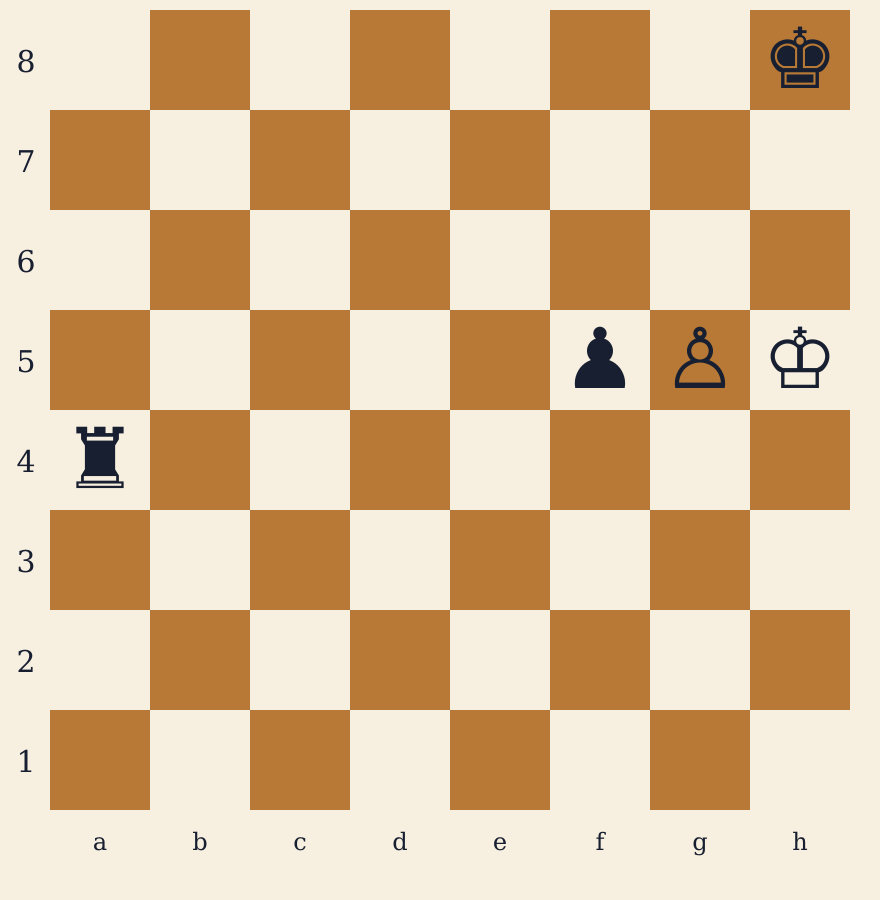
Read the diagram description
Composed board: White king h5 and pawn g5; Black king h8, rook a4 and pawn f5. White to move after f7–f5. The rook is now on a4; all other pieces match the first setup.
View full illustration (opens in a new tab)
Now g5–f6 en passant is legal: after White's pawn reaches f6 and Black's f5-pawn is removed, the rook on a4 does not attack the king on h5.[1] The last move and pawn geometry are unchanged; moving the rook has changed the king-safety answer.[1]
This is a legality lesson, not a promise that capturing is the strongest move or wins the game. After a legal capture, Black still gets a turn.[1] When practising, explain why the move is allowed before trying to evaluate whether you want to play it.
A pawn pinned on a file can fail the same test
Here is a different composed setup with White to move:
- White: king e1, pawn e5.
- Black: king h8, rook e8, pawn d5.
- Black's last move: d7–d5.
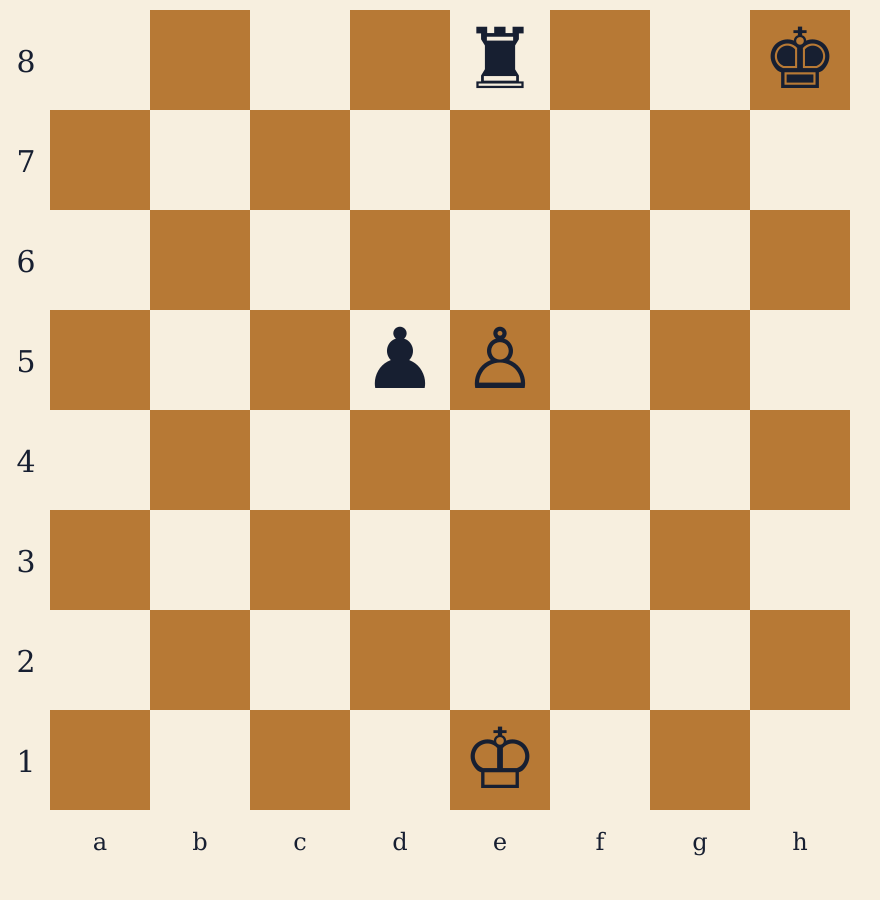
Read the diagram description
Composed board: White king e1 and pawn e5; Black king h8, rook e8 and pawn d5. White to move after d7–d5. The White pawn blocks the e-file.
View full illustration (opens in a new tab)
White cannot play e5–d6 en passant, because leaving the e-file would uncover the rook's attack on the king at e1.[1] The pawn's forward move e5–e6 is legal in this setup: it stays on the e-file and continues to block the rook.[1]
So avoid the shortcut “a pinned pawn cannot move at all.” The relevant question is whether the particular move leaves the king attacked, not whether you have attached the word “pinned” to the pawn.[1] For en passant, always test the capture's complete result.[1]
Does en passant have to be played?
The opportunity itself does not force you to capture: FIDE's pawn rule says the pawn may capture, subject to the other move requirements.[1] If another legal move suits your position, you may choose it, but you lose that particular en-passant opportunity when you do.[1] This does not exempt you from responding to check: if your king is attacked, your chosen move must remove that attack.[1]
Do not confuse permission with preference. “Can I capture?” is a rules question; “Should I capture?” requires looking at what happens next.
A short family practice round
Set up the horizontal-trap position on a spare board outside a game. Ask one learner to name the capturing pawn's destination and the other to name the square of the pawn being removed.
Then ask: “After both changes, what stands between the rook and the king?” In the a5-rook setup, the answer is nothing, so the capture is illegal.[1] Move only the rook to a4 and ask the same question again: the capture is now legal, because the rook is no longer attacking along the king's rank.[1] Finally, try the e-file setup and compare e5–e6 with e5–d6: only the forward move preserves the blocking pawn on the e-file.[1]
Switch roles and explain the answer without moving the pieces first. This is a practice suggestion, not a test of speed or a promise of rating improvement.
The rule to take into your next game
En passant needs an immediate two-square pawn advance beside your pawn, the correct capture geometry and a resulting position in which your own king is safe.[1] Remember all three changed squares, not just the square your pawn lands on.[1] If the capture opens a rook, bishop or queen's line onto your own king, the special pawn rule does not make it legal.[1]
Try the paired setups again later without looking at the answers. A useful explanation is more than “the rules say no”: name the square that becomes empty and show the attack that follows.
Sources
Related stories
Learn the Moves
Can a Pinned Piece Give Check? Absolute and Relative Pins Explained
Pinned does not always mean frozen. Three exact positions separate legal moves, attacks and material risk.
Read the story →
Learn the Moves
When Can You Castle? A Legal-Move Checklist
Can you castle if your rook is attacked? Check movement history, empty squares and the king’s route with three original legal-position examples.
Read the story →