
← The Chronicle · Learn the Moves
Insufficient Material and Dead Positions: What Makes a Draw?
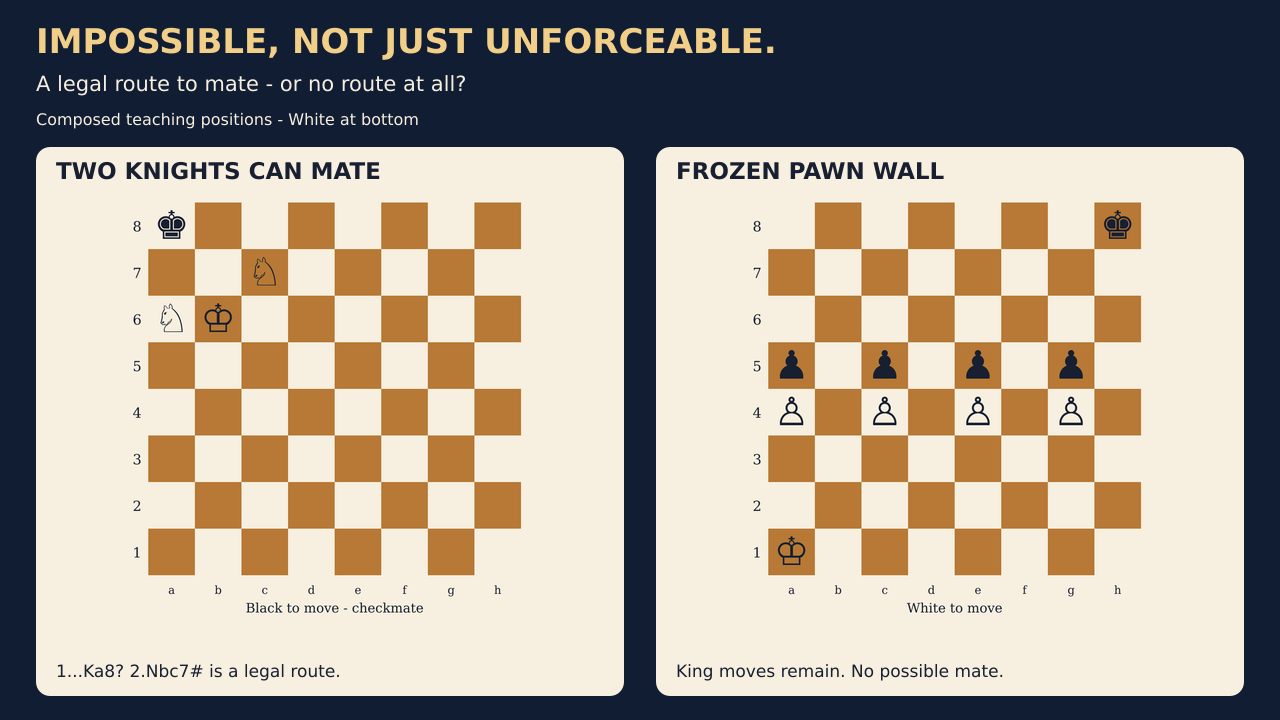
Two knights can checkmate a lone king.[6] That does not mean they can force the king into checkmate against correct defence.[6] The difference explains one of chess’s most confusing draw rules: under FIDE’s dead-position rule, the question is not whether someone can force a win, but whether either player could ever deliver checkmate through any series of legal moves.[1]
A dead position is one in which neither player can possibly checkmate the other. “Insufficient material” commonly describes the familiar cases where the remaining pieces make mate impossible; dead position is the wider test, which can also cover an unbreakable blockade.[1] [5] A website’s result label is not necessarily an exact statement of the FIDE rule, so identify the rules being applied before comparing results.[1] [2] [4]
The test is possible mate, not a forced win
Article 5.2.2 of the FIDE Laws says: “The game is drawn when a position has arisen in which neither player can checkmate the opponent’s king with any series of legal moves.”[1] The article says this immediately ends the game, provided the move producing the position was legal and satisfied its specified handling requirements.[1] It is not a draw offer that an opponent can refuse.[1]
“Any series” includes bad moves.[1] Imagine both players trying to construct a checkmate rather than trying to win against each other: if even one legal continuation reaches mate, that starting position is not dead.[1] This is a way of understanding the rule, not advice to cooperate during a competitive game.
Keep three different questions separate:
- Can I force mate? Can my opponent prevent it by defending correctly?
- Can mate happen at all? Is there any legal route to a checkmate, even after mistakes?
- Is the game already over for another reason? Stalemate, for example, ends the game when the player to move has no legal move and is not in check.[1]
A position can fail the first test while passing the second: two knights against a lone king are the useful example.[6] Do not turn “I cannot make you lose” into “the laws say the game has ended.”[1] [6]
Common insufficient-material positions
The familiar material-only examples are these, with no other pieces or pawns remaining:[5]
- King against king: neither side can construct checkmate.[5]
- King and bishop against king: the bishop and king cannot construct mate against the bare king.[5]
- King and knight against king: the knight and king cannot construct mate against the bare king.[5]
- King and bishop against king and bishop, both bishops on the same square colour: this material combination cannot produce mate.[5]
These are dead-position examples, not merely positions that are difficult to win.[1] [5] In the bishop example, “same colour” means both bishops travel on light squares, or both on dark squares—not that their owners use the same-coloured pieces.[5]
The words against a bare king matter.[4] Do not shorten the rule to “one bishop or knight can never mate”: an opponent’s additional piece can block an escape square and make mate possible.[4] Nor should you turn the last row into “any bishop against any bishop is automatically drawn”; its same-square-colour restriction is part of the example.[5]
Two knights: a legal mate and a legal escape
King and two knights against a lone king do not supply a general forced-mate method against correct defence, but mating positions exist.[6] That is enough to reject a blanket claim that this material is always dead under Article 5.2.2.[1]
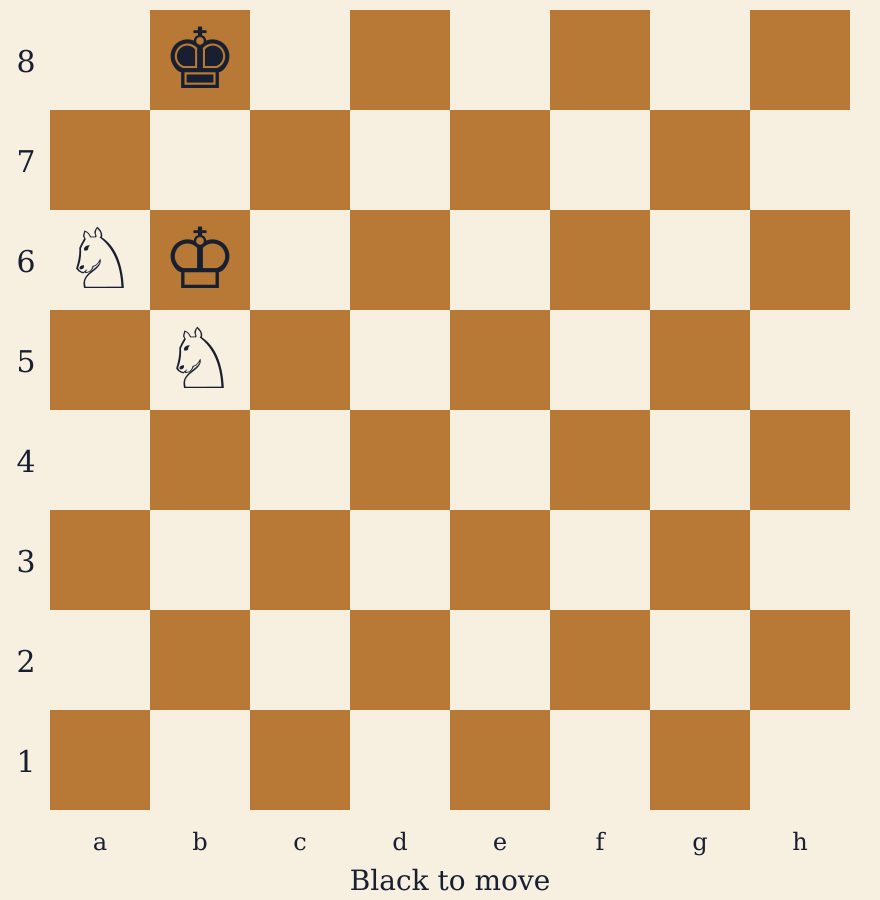
Here is a composed teaching position, with Black to move:
- White: king b6, knights a6 and b5.
- Black: king b8.
- No castling or en-passant rights.
FEN: 1k6/8/NK6/1N6/8/8/8/8 b - - 0 1
Read the diagram description
White-at-bottom board with Black king b8, White king b6 and knights a6 and b5, all other squares empty, Black to move Composed teaching position, Black to move in check: both Ka8 and Kc8 are legal, but only Ka8 permits the immediate mate shown next.
View full illustration (opens in a new tab)
Black is in check from the knight on a6. Compare these two legal choices:
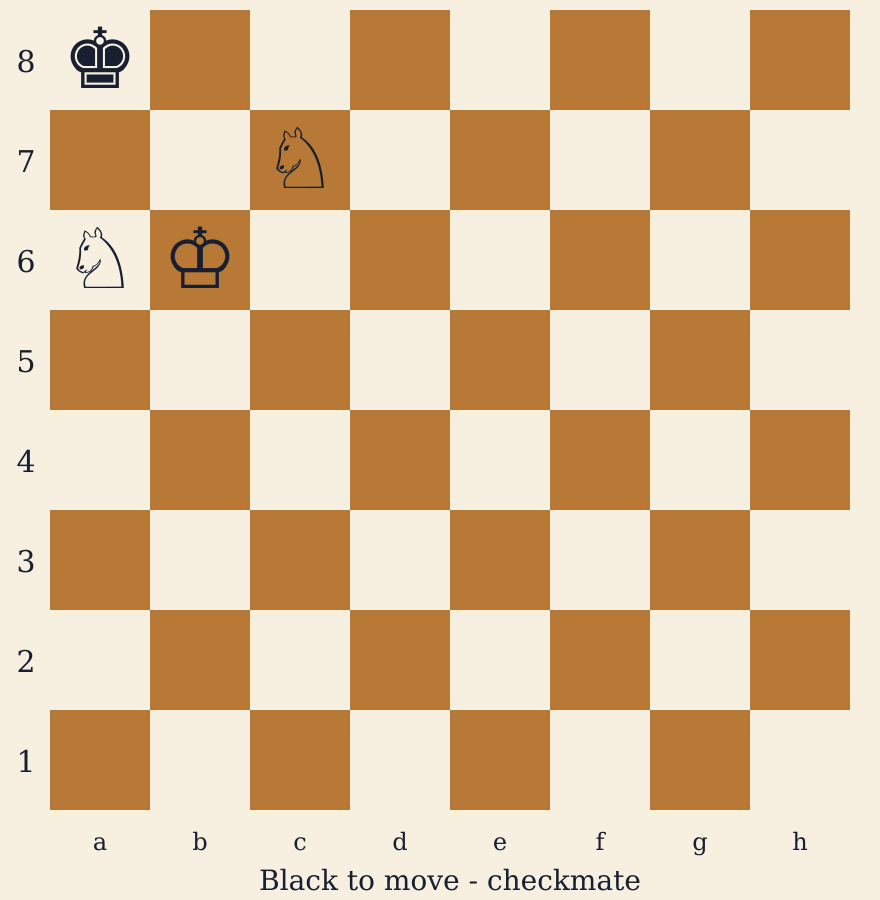
The mating mistake: 1...Ka8? 2.Nbc7#. White moves the knight from b5 to c7. That knight checks a8; the knight on a6 covers b8; White’s king covers a7 and b7. Black has no legal reply. The “b” in Nbc7 identifies which knight moves, because both knights could move to c7.
An escape from the immediate threat: 1...Kc8. Black is no longer in check, and White has no mate in one. This branch demonstrates an alternative to the mating mistake; it is not an exhaustive proof of optimal defence throughout the endgame.
Read the diagram description
White-at-bottom board with Black king a8, White king b6 and knights a6 and c7, all other squares empty, after Ka8 and Nbc7 checkmate After 1...Ka8? 2.Nbc7#, this composed legal mate proves the starting position is not dead, without proving a forced win.
View full illustration (opens in a new tab)
These exact moves and all immediate legal replies were checked with a legal-move library for this article. The example’s job is limited but decisive: a legal route to mate exists from the starting position, so it is not dead.[1] It does not claim that every arrangement of two knights and kings has the same outcome.
Can a position be dead with pawns still on the board?
Yes. Dead position concerns what the actual arrangement permits, not simply the number of pieces remaining.[1] [5] A blocked pawn ending can qualify if neither king can ever break through and no pawn can ever move or capture.[5] An ordinary fortress that holds against good play is not enough: the rule still asks about every legal continuation.[1]
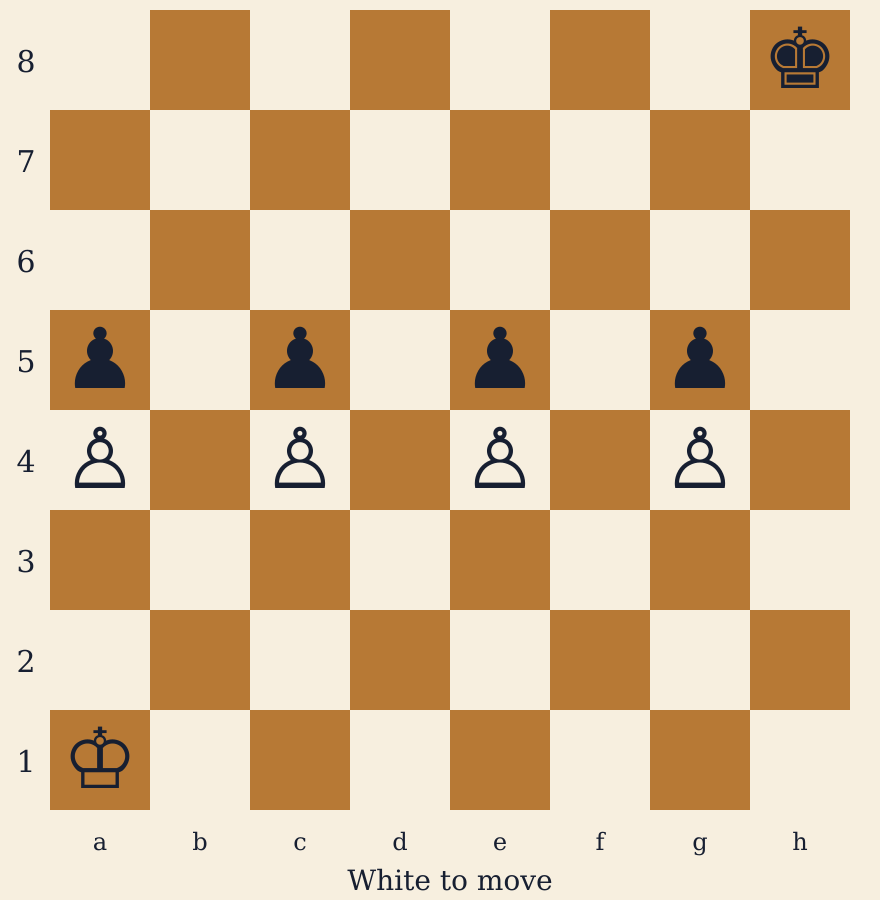
Consider this composed position, White to move:
- White: king a1; pawns a4, c4, e4, g4.
- Black: king h8; pawns a5, c5, e5, g5.
- No castling or en-passant rights.
FEN: 7k/8/8/p1p1p1p1/P1P1P1P1/8/8/K7 w - - 0 1
Read the diagram description
White-at-bottom board with White king a1 and pawns a4, c4, e4, g4, Black king h8 and pawns a5, c5, e5, g5, all other squares empty Composed dead position, White to move: every pawn is blocked and king moves remain, but neither king can cross the fixed barrier.
View full illustration (opens in a new tab)
Each pawn is blocked by the pawn directly ahead. There are no diagonally adjacent enemy pawns to capture. White’s king cannot enter the gaps on the fourth rank because Black’s pawns attack them; Black’s king faces the matching barrier on the fifth rank. Neither king can reach an opposing pawn to capture it. The barrier cannot change.
Unlike stalemate, this position allows king moves. But moving the kings around their separate regions cannot create a checkmate: the pawn attacks remain fixed, and the kings can never meet across the barrier. That makes it a dead position under the FIDE test.[1]
The accompanying verification exhausts the reachable legal-move graph for this exact setup, rather than treating an engine’s “draw” evaluation as proof. It checks that no pawn move, check or mate appears. This is a proof about the supplied position’s continuations, not a reconstruction of a full game from the initial array. Do not apply its conclusion to a different pawn wall without checking captures, king entry and possible promotion routes again.
What changes when a flag falls?
The dead-position rule asks whether either player can ever mate.[1] The ordinary FIDE flag-fall exception asks a one-sided question: can the player who still has time checkmate the player whose time expired through any possible series of legal moves?[1]
Article 6.9 normally makes failure to complete the required moves in time a loss, subject to its listed exceptions; it makes the result a draw when the opponent cannot possibly deliver mate.[1] This is not a requirement that the opponent demonstrate a forced win.[1]
For example, a bare king cannot earn a timeout win against an opponent’s king and rook: it has no possible legal mate.[1] [5] Reverse whose flag falls and the answer need not be the same, because the rook side can have mating possibilities.[1] Examine the actual position and the side with time remaining—not just which player has more material.[1]
Why an online result may look different
FIDE’s cited Laws explicitly cover over-the-board play.[1] Online services also have their own implementation policies and published guidance.[2] [3] [4]
Lichess quotes the FIDE possible-mate test in its timeout FAQ.[4] It also warns that some forced lines and fortresses are difficult to decide automatically and says it defaults to the player who did not run out of time.[4] Its documentation is therefore not a promise that software detects every dead position perfectly.[4]
Chess.com’s documentation needs care. Its insufficient-material page describes two knights against a lone king as a draw, while its timeout page explicitly says that running out of time against a king and two knights produces a loss.[2] [3] These passages address different triggers and should not be flattened into one universal two-knight rule.[2] [3] They also do not establish how every position is adjudicated by the current server.
Use those pages to understand the service’s stated guidance, not to replace FIDE’s text or infer another federation’s rules.[1] [2] [3] Save the finished game and its result message if you need to ask the platform about an unexpected decision. No live platform adjudication experiment is claimed here.
A practical way to remember it
Start with impossible, not merely unforceable.[1] If you think the position is dead, ask whether either player could help construct a legal mate, whether a capture could open the board, and whether a pawn could eventually promote.[1] If any such legal route reaches mate, Article 5.2.2 does not end that position as dead.[1]
At a tournament, seek the arbiter’s assistance if the result is disputed; the Laws permit pausing the clock to seek that assistance.[1] For practice after a game, set up the two-knight example on a board and compare Ka8 with Kc8 before revealing the mating move. Explain which escape squares disappear: the useful lesson is the reasoning, not just the result label.
For more chess reading, explore the Chronicle. The key distinction to take into your next game is small but important: a win you cannot force is not the same thing as a mate that cannot happen.[1] [6]